Pareja de Hecho in Valencia: Register and Residence
You can register as a pareja de hecho in the Comunitat Valenciana if you are both of age and live together at an address where you are both on the padrón, and it costs nothing. Registering does not itself grant residence, but residence rules name a registered partner as a family member.
On this page
If you and your partner live together in Valencia and want it on paper, yes: you can register as a pareja de hecho (a registered de facto partnership) with the Generalitat, and it costs nothing. The catch is what it does not do. Registering does not hand your partner a residence permit, it gives you a document that the national residence rules name as proof of your relationship when you apply.
This page keeps the two layers apart: first the Valencian registry, then the national rules on residence. If you are a foreign resident who wants to bring a partner from abroad, the income and housing tests are on the family reunification page.
Can you register as a pareja de hecho in Valencia?
Yes, if you are both of age, live together as a couple in the Comunitat Valenciana and are free of the bars listed below. The registration itself creates the formalised union, so the registry’s decision is what counts, not the date you moved in together.
The requirements
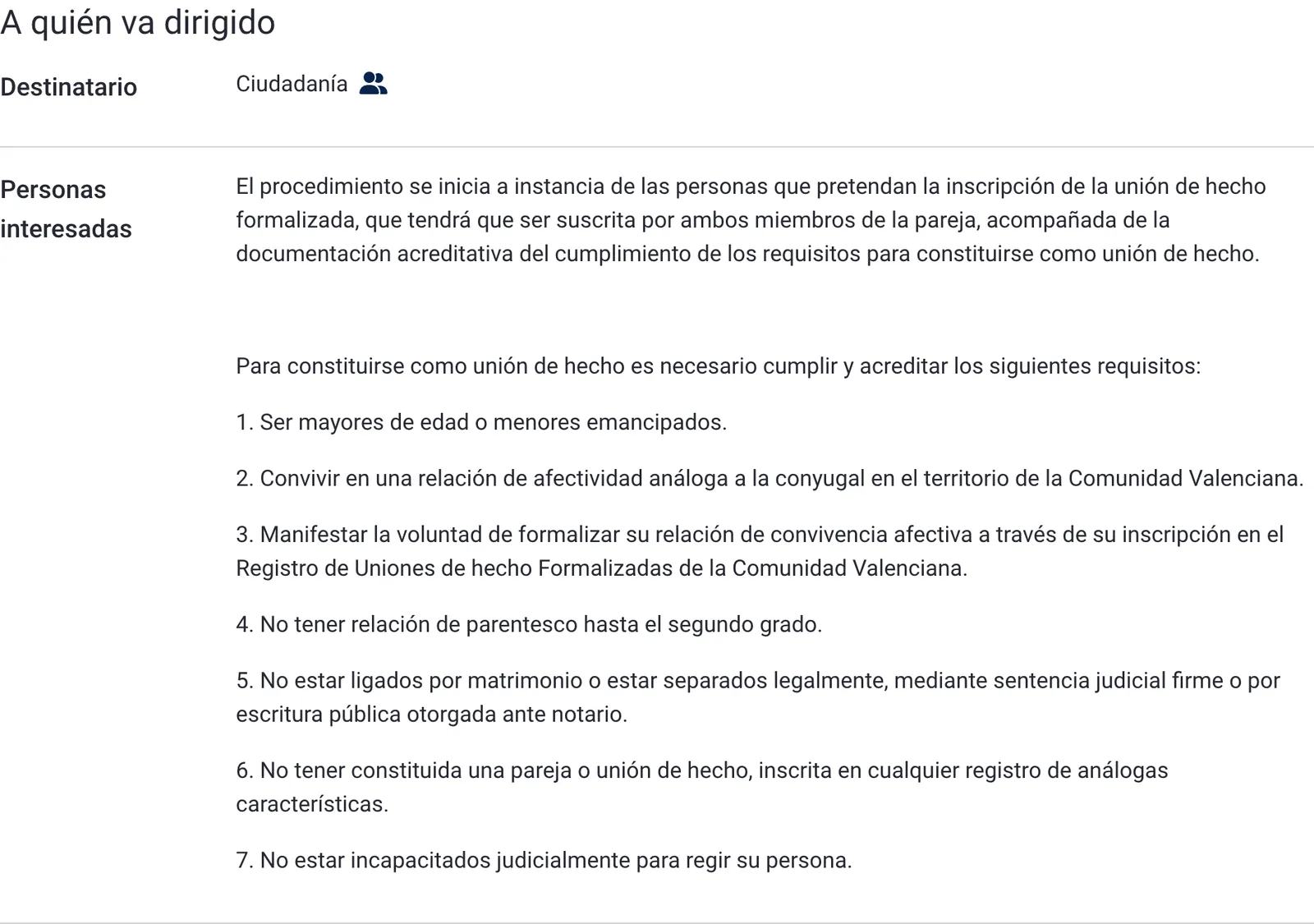
- Both of you are of age or emancipated minors, and you live together in a relationship analogous to marriage in the Comunitat Valenciana.
- You are not related up to the second degree.
- Neither of you is married, unless legally separated by a final court judgment or a public deed before a notary.
- Neither of you has a union registered in any similar registry, and neither is judicially incapacitated.
Both of you on the padrón at the same address
Living together is proved with the certificate of empadronamiento (the padrón certificate) showing both of you at one address in the Comunitat Valenciana on the day you file, and the short registration slip is not valid. If work, family or legal reasons temporarily stop you registering at the same address, you state that in a sworn declaration and attach whatever supports it for the office to assess.
We recommend sorting the padrón first, because every other paper hangs on it: the empadronamiento guide walks through how to get both of you on one address and how to ask for the certificate.
What do you hand in?
Bring your IDs, the padrón certificate, proof of your civil status and, for any paper issued abroad, an apostille and a sworn translation.
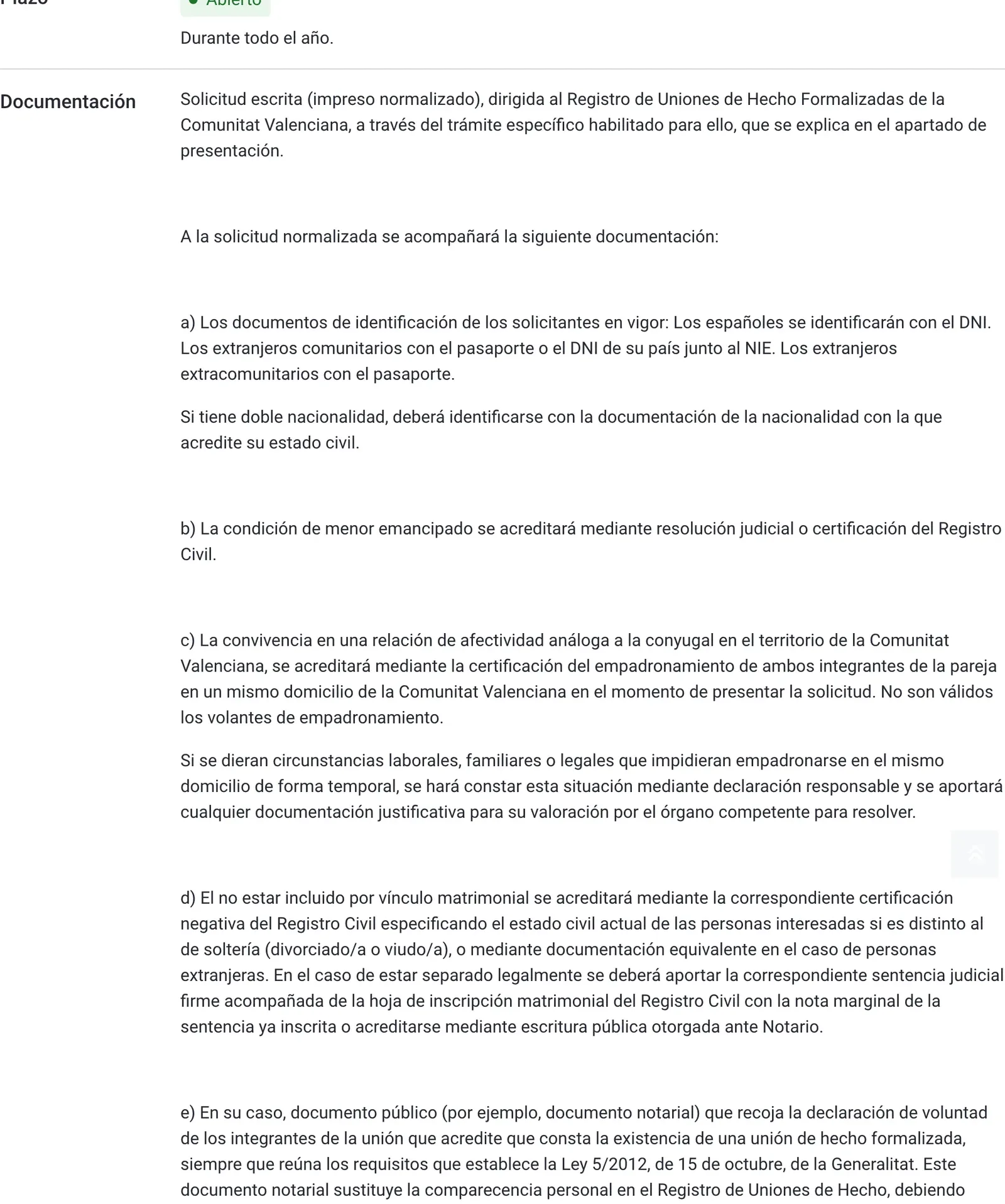
- ID. Non-EU citizens use the passport. EU citizens use the passport or their national ID together with the NIE.
- Padrón certificate. Both of you at the same address in the Comunitat Valenciana.
- Civil status. A negative certificate of the Civil Registry stating your status if you are divorced or widowed, or equivalent documents if you are a foreigner.
- Apostille. A public document issued abroad needs an apostille from the issuing country, or legalisation by the Spanish consulate and the foreign-affairs ministry. The apostille and sworn translation guide covers how to get each.
- Sworn translation. Documents are translated by a sworn translator-interpreter of the Foreign Ministry; if a non-EU citizen had the translation made in the country of origin, it must be apostilled.
All of these must be originals issued no more than three months before you file, so get them last, once you know the date you can submit. Filing is free.
How do you file, and what happens next?
File the application signed by both of you, online if at least one of you has a digital-signature certificate the Generalitat accepts, otherwise on paper at a registro de entrada.
- Choose your route. Online filing needs a certificate for at least one of you; the digital certificate guide explains how to get one. Without a certificate, fill in the form online, print it, sign it and file it at a registro de entrada, because the application is not registered until it is filed in person.
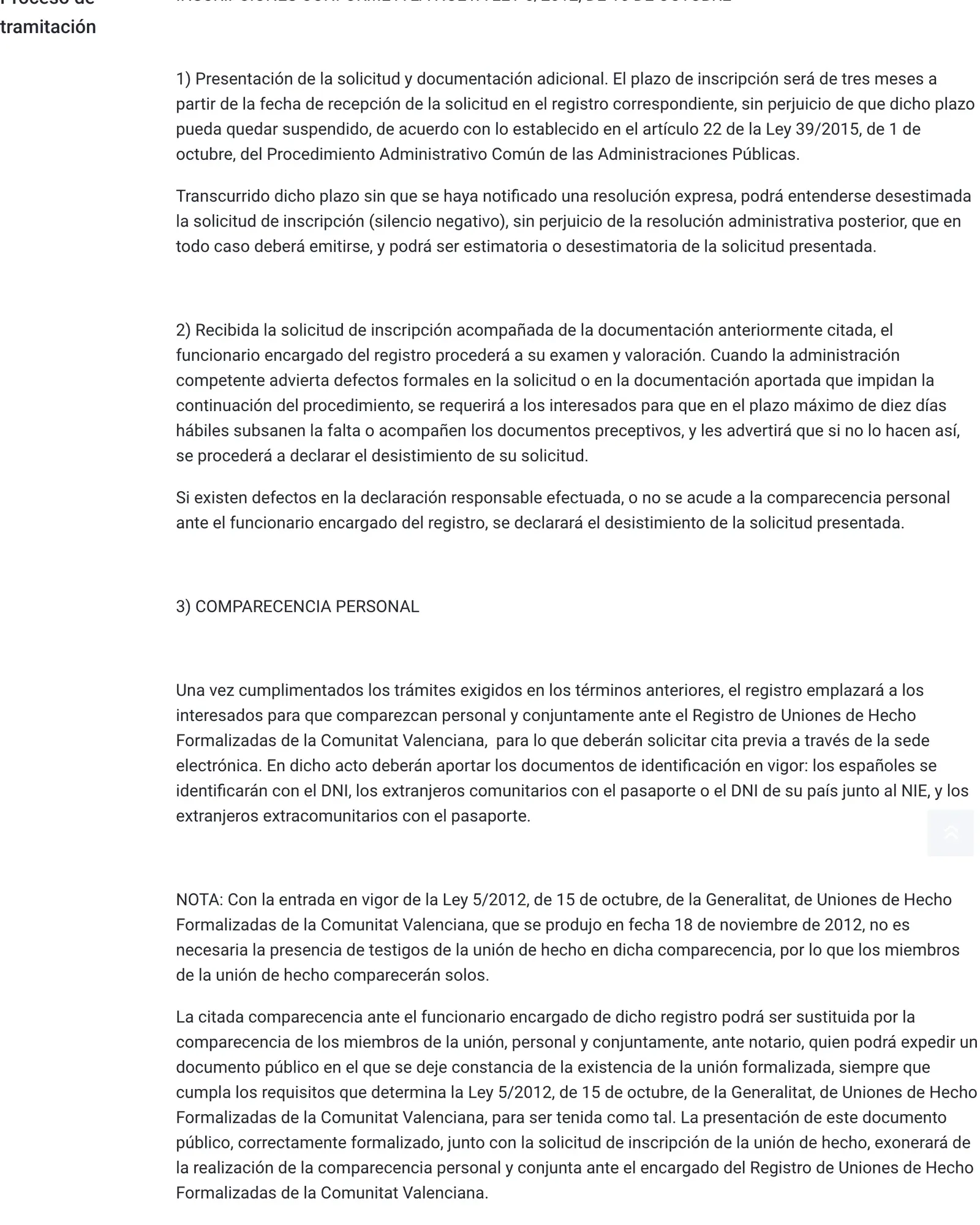
- Fix any defects quickly. If the file has formal defects, the registry gives you ten working days to correct them or add the missing documents, and declares the application withdrawn if you do not.
- Book the appointment. After review, the registry summons you to appear together and personally, and you book a cita previa through the sede electrónica. No witnesses are needed, so you appear alone.
- Consider the notary. Appearing together before a notary, who records the union in a public document, replaces the appearance at the registry when you file that document with your application.
- Wait for the resolution. It is due within three months of the application, and after that time without an express resolution your application may be understood as refused.
The Valencia-province registry is at C/ de la Democracia 77, Ciudad Administrativa 9 de Octubre, Torre 4, 46018 València. Its email for processing questions in the province of València is registreunionsfetcv@gva.es, and it is not for official filing.
If you split up or one of you marries
A union ends when either of you says so, by agreement, or when one of you marries or you stop living together without justification for at least three months. Then either of you must apply to cancel the registration within one month. The residence side of a split is in the section on Spanish citizens below.
What does registration give you in Valencia?
Mostly equal treatment with spouses in the Generalitat’s own public-law matters, while the Constitutional Court struck down the law’s articles on the couple’s civil rights.
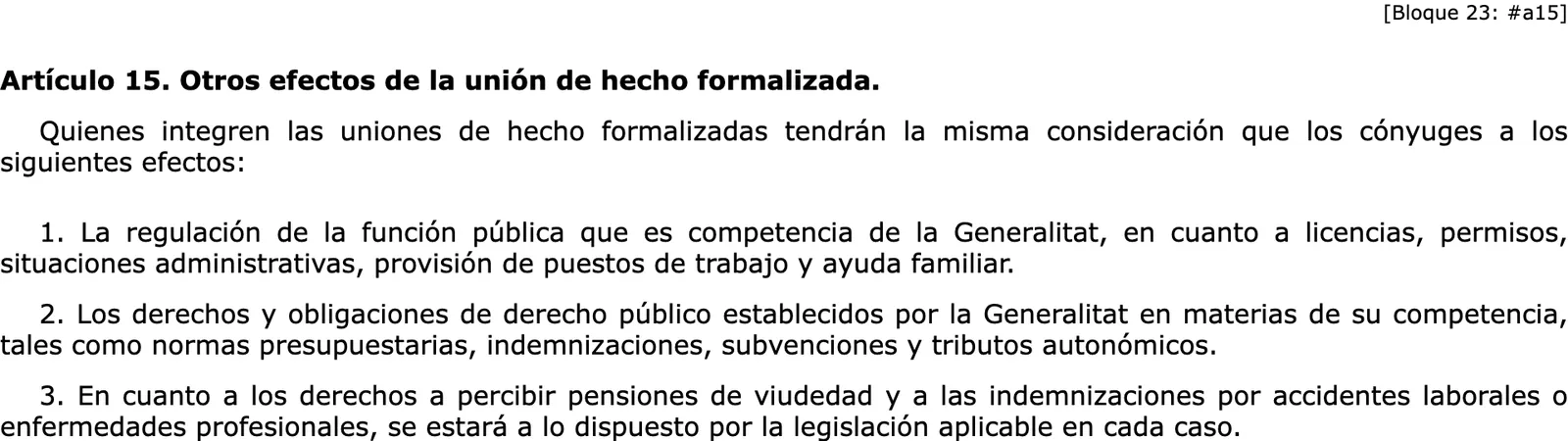
Quienes integren las uniones de hecho formalizadas tendrán la misma consideración que los cónyuges a los siguientes efectos: … 2. Los derechos y obligaciones de derecho público establecidos por la Generalitat en materias de su competencia, tales como normas presupuestarias, indemnizaciones, subvenciones y tributos autonómicos.
Members of formalised de facto unions will be treated like spouses for the following purposes: … 2. The public-law rights and obligations established by the Generalitat in matters within its competence, such as budget rules, compensation, grants and regional taxes.
BOE · Ley 5/2012 de la Comunitat Valenciana, art. 15
The same article treats you like spouses for the Generalitat’s civil-service rules on leave, permits, administrative situations, filling of posts and family allowance. For widow’s pensions and compensation for work accidents or occupational illness, the legislation that applies in each case decides. For the Valencian inheritance and gift tax, you are treated as spouses if your union meets the Valencian law and is registered, and the full rules are in Inheritance and Gift Tax in Valencia.
Do not count on rights beyond that. The Constitutional Court declared articles 2 and 6 to 14 of the law unconstitutional and void in its ruling of 9 June.
Does registering get your partner residence? The national rules
No: registration alone does not grant residence, but the national rules name a registered partnership as a family relationship when you apply through the Oficina de Extranjería.
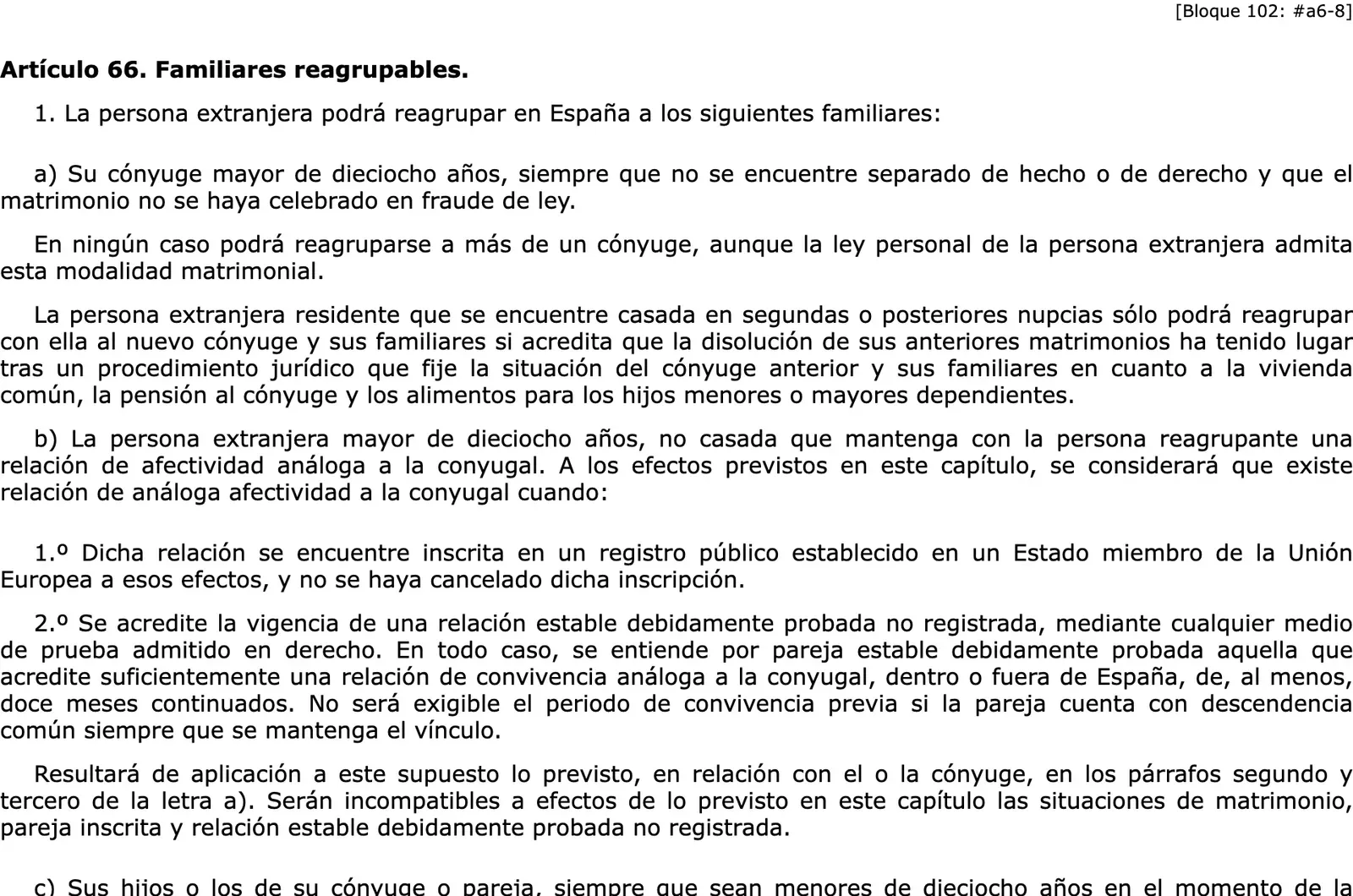
Spain’s current immigration regulation repealed the previous one, Royal Decree 557/2011, so anything written under that text may be out of date. The wording on registered partners that matters for most readers is this.
Dicha relación se encuentre inscrita en un registro público establecido en un Estado miembro de la Unión Europea a esos efectos, y no se haya cancelado dicha inscripción.
The relationship is registered in a public register established for that purpose in an EU member state, and the registration has not been cancelled.
BOE · Real Decreto 1155/2024, art. 66.1.b
If you are a foreign resident bringing a partner
You can reunify an unmarried foreign partner over eighteen whose relationship with you is registered in a public register established for that purpose in an EU member state, as long as the registration has not been cancelled. You file once you have lived in Spain at least one year and have applied for authorisation to reside for at least another year.
The regulation also accepts an unregistered couple who can prove at least twelve continuous months of living together as a couple, inside or outside Spain, with no prior cohabitation needed if you have children together. Registered partnership, marriage and an unregistered stable relationship are incompatible with each other for this purpose.
If you are on the arraigo route
When you apply for arraigo social on the basis of family ties with a foreigner who holds a residence authorisation, a registered partner counts as one of those ties, alongside the spouse and first-degree relatives in direct line. The arraigo guide has the rest of the route.
What if your partner is a Spanish or EU citizen?
A partner of a Spanish national can apply for a temporary residence authorisation as a family member, provided you live together, and a registered partnership is one of the relationships listed.
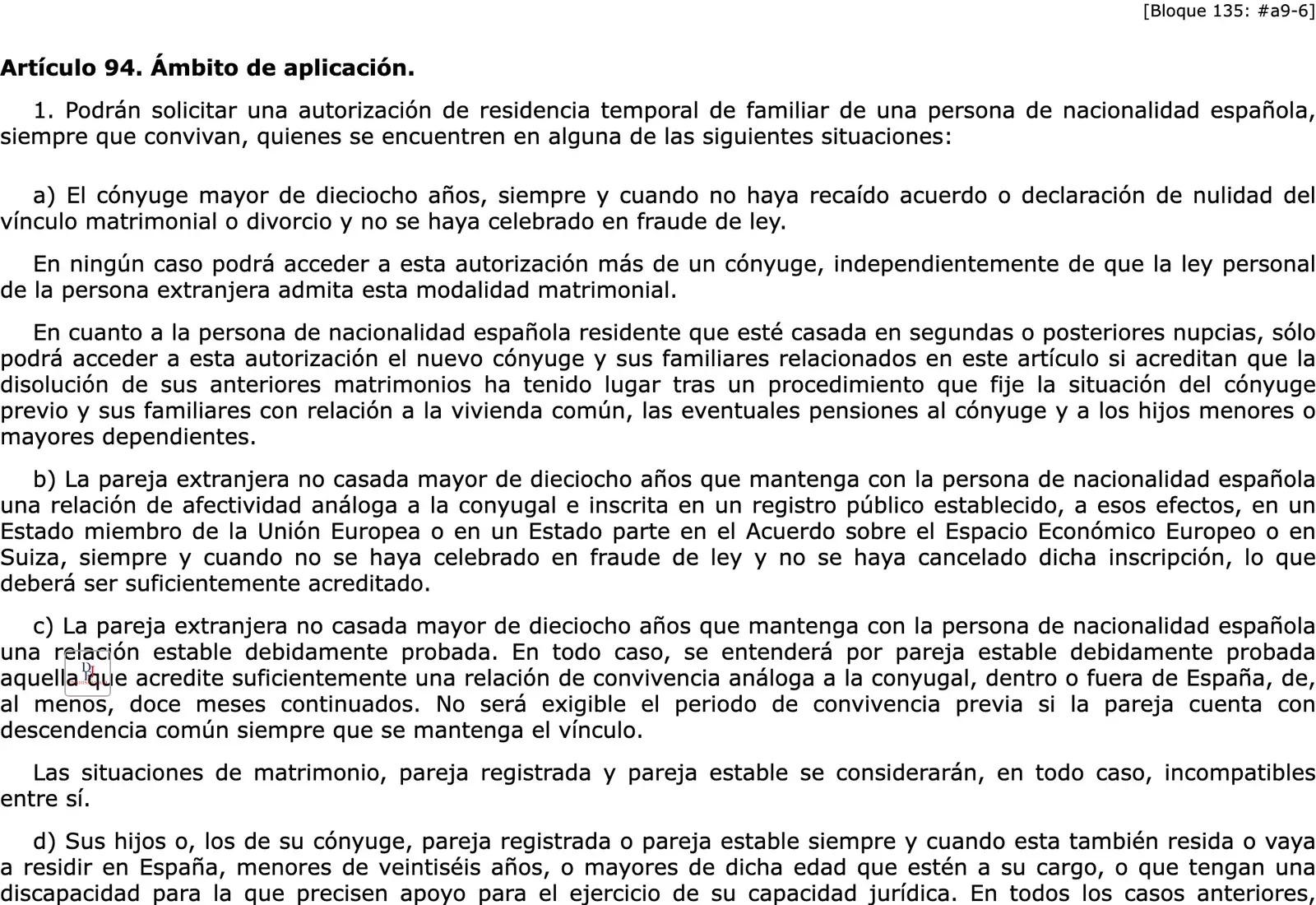
Partner of a Spanish citizen
The listed partner is an unmarried foreign partner over eighteen in a relationship analogous to marriage. The relationship must be registered in a public register established for that purpose in an EU or EEA state or in Switzerland, not entered into in fraud of law, and not cancelled. An unregistered partner can also qualify with at least twelve continuous months of cohabitation, and registered partnership, marriage and stable partnership are incompatible with each other.
When the Spanish partner is in Spain and the foreign partner is in the country of origin, the Spanish partner files at the Oficina de Extranjería of the province where they live. Once it is granted, the foreign partner applies for the visa at the Spanish consulate. Exceptionally, if both of you are already in Spain, either of you can apply in Spain. The Spanish partner adds a sworn statement that no other spouse or partner lives with them in Spain, and you add documents proving your family bond.
The authorisation gives its holder the right to reside and work with no further procedure while the conditions are maintained, and it is valid for five years or for the Spanish partner’s planned stay in Spain if that is shorter. If the registration is later cancelled, the foreign partner must tell the competent authorities within six months.
Partner of an EU or EEA citizen
The regulation for EU and EEA citizens covers, whatever their nationality, certain family members of a citizen of another EU or EEA state who accompany or join that citizen. The list includes the partner in a union analogous to marriage registered in a public register established for that purpose in an EU or EEA state, one that prevents two simultaneous registrations, if it has not been cancelled. The EU citizen registration guide covers the registration side of this route.
An unregistered partner can ask to be covered if the relationship is duly proven. That includes at least one continuous year of living together as a couple, unless you have children in common, in which case proof of stable cohabitation is enough. The authorities assess each such case individually and decide with reasons, so treat the outcome as one that may go either way rather than as an entitlement.
How the permit then turns into a card is in the NIE vs TIE guide.
Step by step
- Check you both qualifyYou are both of age, live together as a couple in the Comunitat Valenciana, are not related up to the second degree, not married unless legally separated, and have no other registered union.
- Register both of you on the padrón at one addressAsk the Ajuntament for the certificate for both of you at the same address; the short slip is not valid.
- Gather originals no more than three months oldPassport (EU citizens: passport or ID plus NIE), civil-status proof, apostille and sworn translation for foreign papers.
- File the applicationOnline if one of you has a digital-signature certificate the Generalitat accepts, otherwise print, both sign and file it at a registro de entrada.
- Appear together and wait for the resolutionBook a cita previa and appear in person, without witnesses; the resolution is due within three months.
Not confirmed: Whether the Oficina de Extranjería de València accepts a Valencian registration as the "public register" the regulation names, which does not name regional registers. Confirm with the office before you file. The EU-citizen rule also asks for a register that prevents two simultaneous registrations, and no official text says whether the Valencian one does.
Common questions
Do we need witnesses when we appear at the registry?
Witnesses are not needed at the appearance, so you and your partner appear alone.
Can I register if I am divorced or still legally separated?
You must not be bound by marriage, so you need to be unmarried or legally separated by a final court judgment or a public deed before a notary. A divorced or widowed applicant proves it with a negative certificate of the Civil Registry showing that status, or with equivalent papers if you are a foreigner.
Does it cost anything?
No fee is charged for the registration procedure. Your own costs are the sworn translations and any apostilles for documents issued abroad.
What happens if the registry does not answer?
After three months without an express resolution your application may be understood as refused, although a resolution must still follow later.
Does a partnership registered in another EU country count?
For the national reunification rules, a relationship registered in a public register established for that purpose in an EU member state counts if the registration has not been cancelled. The Valencian registry, however, will not register you if you already have a union registered in any similar registry.
Do we have to register, or can we just live together?
Registration is one route. An unregistered couple can also qualify with at least twelve continuous months of living together as a couple, inside or outside Spain.
Can my partner work if the family permit is granted?
A partner who holds the residence authorisation for family of a Spanish national has the right to reside and work, with no further procedure, as long as the conditions are maintained.
What do we do if we split up?
Either of you must apply to cancel the registration within one month. A foreign partner holding a family permit of a Spanish national must tell the authorities within six months of a cancellation.
Read next
Sources and reader comments
Official legal texts (BOE, DOGV, government portals):
- Generalitat Valenciana (sede electrónica): Procedure 917, solicitud de inscripción de una unión de hecho en el Registro de Uniones de Hecho Formalizadas de la Comunitat Valenciana (opens in a new tab)
- BOE consolidated text: Real Decreto 1155/2024, de 19 de noviembre, Reglamento de la Ley Orgánica 4/2000 (arts. 66, 68, 94-99, 127; last update 22/09/2026) (opens in a new tab)
- BOE consolidated text: Real Decreto 240/2007, de 16 de febrero, sobre entrada, libre circulación y residencia de ciudadanos de la UE y del EEE (arts. 2-3; last update 09/11/2015) (opens in a new tab)
- BOE consolidated text: Ley 5/2012, de 15 de octubre, de Uniones de Hecho Formalizadas de la Comunitat Valenciana (BOE-A-2012-13776; partly annulled by STC 110/2016) (opens in a new tab)
- Ley 13/1997, de 23 de diciembre, de la Generalitat, tramo autonómico del IRPF y restantes tributos cedidos, art. 12 quáter (BOE consolidated text, last update published 10/08/2026) (opens in a new tab)
General information checked against the sources listed above, not legal advice for your situation. Rules and office practice change; confirm with the immigration office or a licensed adviser before you act. See how guides are checked.
Spotted an error? Report it.
Comments (0)
Be the first to ask about this topic.