Family Reunification in Spain: Rules and Income (2026)
You can bring your spouse, partner, children or parents once you have lived in Spain a year and applied for a second year. You need income of 150% of the IPREM for you plus one relative, and 50% for each extra member. At the 2023 IPREM of €600, still in force, that is €900 a month for two.
On this page
As a foreign resident you can bring your spouse, partner, children or parents to Valencia through family reunification (reagrupación familiar). You can file once you have lived in Spain a year and applied for a second year. Then you apply in person at the Oficina de Extranjería.
Who can you bring to Spain?
Most people think of a spouse or children, but the list is wider.
- Spouse. Over eighteen and not separated. You can only ever reunify one spouse.
- Partner. Either a partnership registered in an EU member state, or a stable couple with at least twelve months of continuous cohabitation. To register your partnership in Valencia, see registering as a registered de facto partnership.
- Children. Yours or your partner’s, under eighteen when you file. Adults only count if they have a disability or cannot support themselves for health reasons.
- Parents. First-degree ascendants of you or your spouse or partner, if they depend on you, are over sixty-five and there are reasons that justify their residence in Spain.
If the child belongs to only one of you, that parent needs sole parental authority or exclusive custody (with further conditions in the regulation), or, with shared custody, the other custody holder must consent to the child living in Spain.
How long must you live in Spain first?
You must have lived in Spain for a year and applied for at least another year. The grant also waits for your renewal: your relative’s permit is not granted until your own permit has been renewed, or long-term residence granted.
Holding long-term residence granted in Spain? Then you can reunify your parents without the one-year wait.
What income do you need to show?
The income test counts the whole family unit: 150% of the IPREM for you plus one relative, and 50% for each extra member. The monthly IPREM is €600, the 2023 figure that still applies while the budget stays extended, so you need €900 a month for you and one relative. Each extra member adds €300.
ingresos, rentas o rendimientos de carácter periódico equivalente, en euros o su equivalente legal en moneda extranjera, al 150 % del IPREM, en unidades familiares que incluyan a la persona reagrupante y a un familiar reagrupado, y del 50 % del IPREM por cada miembro adicional.
income, rents or periodic returns equivalent, in euros or its legal equivalent in foreign currency, to 150% of the IPREM, for family units including the sponsor and one reunified relative, and 50% of the IPREM for each additional member.
BOE · Real Decreto 1155/2024, art. 67.1
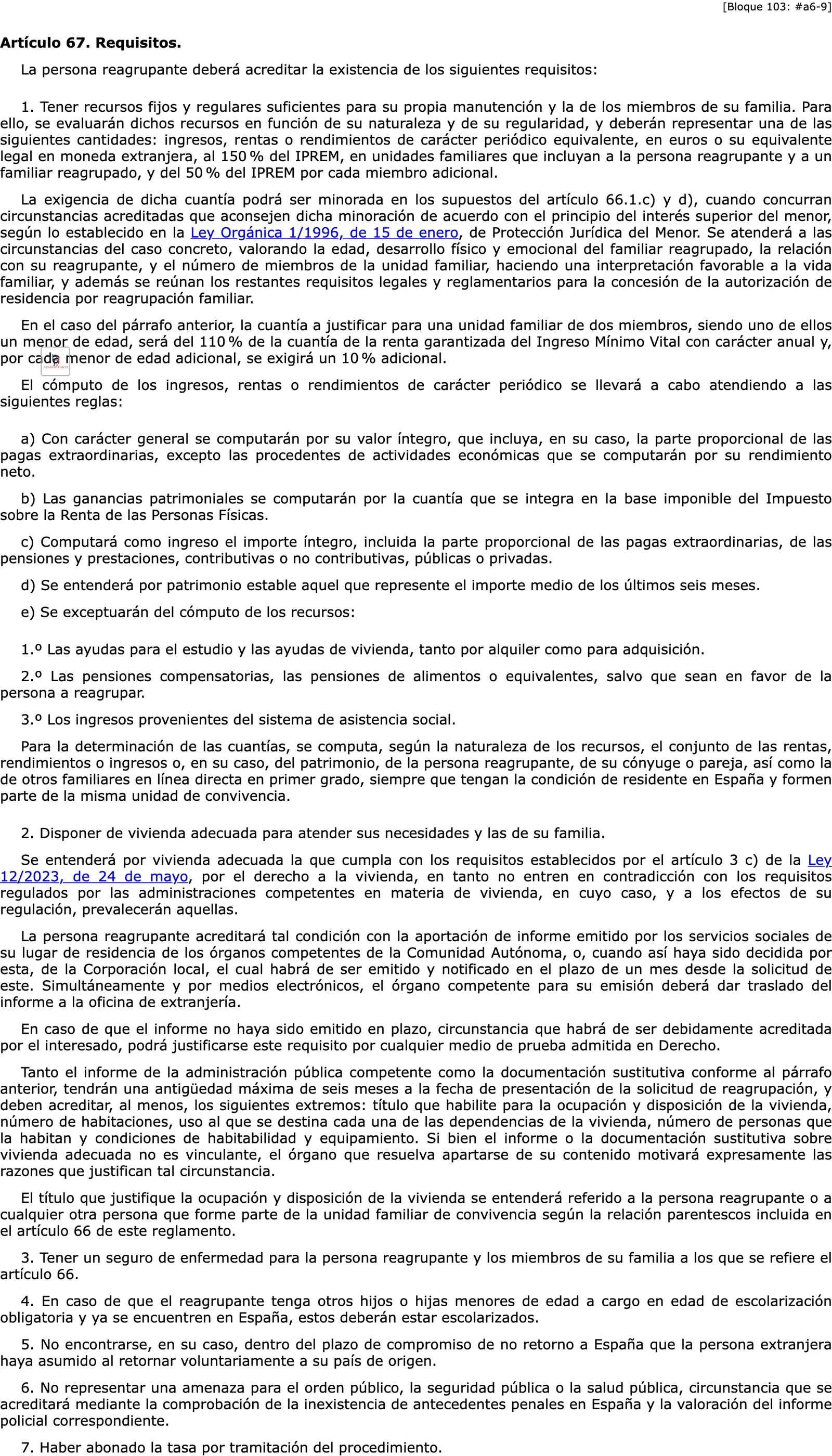
Savings are measured as the average amount of the last six months. Your spouse’s or partner’s income counts too, as long as they are residents in Spain and share your household.
What housing proof do you need?
Ask the social services of your place of residence for a housing report, which must be issued within one month of your request. The report must be at most six months old when you file. If it arrives late, document the delay and you can prove the housing by other means.
The padrón “vivienda” certificate shows how many people are registered at your address. Register first with the empadronamiento guide.
You also need health insurance for you and your relatives; the health insurance guide covers what the law asks. Any other minor children of yours already in Spain at school age must be enrolled in school.
Steps to apply
- Check the timing: a year in Spain plus an application for a second year.
- Gather your documents: a complete copy of your passport, proof of income and the housing report. For a spouse or partner, add your statement that no other spouse or partner lives with you in Spain.
- Gather your relative’s documents: a complete copy of the passport and proof of the family tie. For apostilles and sworn translations, see the apostille guide.
- Pay the fee, then book the appointment.
- File on the official form, in person.
- Wait for the decision, which comes within two months; silence after that counts as a rejection.
Where to file in Valencia
The Oficina de Extranjería has three sites; Sede 1 is at Calle Diputada Clara Campoamor esquina Motilla de Palancar, 23. Check which site handles reunification before you go. At the moment, in-person appointments are requested by email at citaextran.valencia@correo.gob.es. The cita previa guide walks through the booking.
You can also file electronically on form EX02. For that you need a recognised digital certificate or an electronic DNI; see the digital certificate guide.
What does it cost?
The initial fee is €10.94, and renewal costs €16.40.
After the grant
The permit takes effect only after your relative gets the visa and enters Spain, which must happen within one month. Your relative can then work without extra procedures, once above the minimum working age. After arrival, follow the TIE guide.
After one year on the reunification permit, a spouse or partner can apply for an independent residence-and-work permit if they meet one of the requirements in the regulation. To renew, file in the two months before expiry or within the three months after.
Family of a digital nomad visa holder
Relatives of an international teleworker follow a different law. They can apply jointly with the holder, at the same time or one after the other. If they file at the same time, the authorisation and visa are decided together. Details for the holder are in the digital nomad visa guide.
Family of a Spanish or EU citizen
A non-EU relative of a Spanish national uses a separate chapter of the regulation. The procedure is free, and a relative already in Spain gets a permit valid for up to 5 years from the grant. For family of an EU citizen, start with the EU citizen registration guide.
Step by step
- Check the timingFile once you have lived in Spain a year and applied for a second year.
- Gather your documentsYour passport, proof of income, the housing report and health insurance for you and your relatives.
- Gather your relative's documentsA complete copy of the relative's valid passport and proof of the family tie.
- Pay the feeThe initial fee is €10.94.
- File at the Oficina de ExtranjeríaApply on the official form, in person or electronically.
- Wait for the decisionThe decision comes within two months.
- Relative gets the visa and enters SpainThe permit takes effect after the visa and entry, which must be within one month.
Not confirmed: The 2026 IPREM figure: the sourced text is the 2023 budget law, still in force while the budget stays extended. Confirm the amount with the Oficina de Extranjería before you file. Also unclear is how the Ajuntament issues the housing report; the regulation names the social services of your place of residence.
Common questions
How long must I live in Spain before I can bring my family?
You can file once you have lived in Spain for a year and applied to stay for at least another year. Your relative's permit is not granted until your own permit has been renewed, or long-term residence granted.
How much income do I need to bring my spouse?
The test is 150% of the IPREM for you plus one relative, and 50% for each additional member. With the 2023 IPREM of €600 a month still applied while the budget is extended, that comes to €900 a month for you and one relative.
Can my reunified spouse work in Spain?
Yes. A reunified spouse, partner or child above the minimum working age can work with no further procedure.
Can I bring my parents to Spain?
Yes, if they are your first-degree ascendants (or your spouse's or partner's), depend on you, are over sixty-five and there are reasons that justify their residence in Spain.
What housing proof do I need?
A report from the social services of your place of residence, which must be issued within one month of your request. It must be at most six months old when you file.
How long does the decision take?
The office decides within two months, and silence after that counts as a rejection.
Read next
Sources and reader comments
Official legal texts (BOE, DOGV, government portals):
- BOE consolidated text: Real Decreto 1155/2024, de 19 de noviembre, Reglamento de la Ley Orgánica 4/2000 (last update 22/09/2026 per BOE) (opens in a new tab)
- BOE consolidated text: Ley 31/2022, de 23 de diciembre, de Presupuestos Generales del Estado para el año 2023 (disposición adicional nonagésima: IPREM) (opens in a new tab)
- Ministerio de Hacienda (SEPG): Prórroga del Presupuesto para 2026 (page last updated 2/1/2026) (opens in a new tab)
- BOE consolidated text: Orden PJC/617/2025, de 13 de junio, importe de las tasas por tramitación de autorizaciones administrativas y documentos de identidad en materia de inmigración y extranjería (opens in a new tab)
- Sede electrónica de Administraciones Públicas: Solicitudes Telemáticas de Autorizaciones de Extranjería (Mercurio) (opens in a new tab)
Show 4 more sources
- Ajuntament de València, sede.valencia.es: Certificado de empadronamiento (PA.CE.10); archived copy (opens in a new tab)
- Ministerio de Política Territorial: Directorio de la Subdelegación del Gobierno en Valencia (Oficina de Extranjería sedes 1, 2, 3) (opens in a new tab)
- Subdelegación del Gobierno en Valencia, Oficina de Extranjería: Folleto informativo octubre 2026 (PDF; tables updated 05/10/2026) (opens in a new tab)
- BOE consolidated text: Ley 14/2013, de 27 de septiembre, de apoyo a los emprendedores y su internacionalización (last update 09/04/2025 per BOE) (opens in a new tab)
General information checked against the sources listed above, not legal advice for your situation. Rules and office practice change; confirm with the immigration office or a licensed adviser before you act. See how guides are checked.
Spotted an error? Report it.
Comments (0)
Be the first to ask about this topic.