Spain Digital Nomad Visa Requirements (2026)
Work remotely for a company outside Spain and not from the EU? You can apply, as an employee or a freelancer. You need a degree or three years of experience, a foreign company active for one year, three months of work history, health cover and income of 200% of the SMI.
Also in: Deutsch
On this page
Do you qualify?
Working remotely for a company outside Spain? The permit is for a non-EU adult who works remotely for companies outside Spain, using exclusively IT, telematic and telecommunication means. The job itself must be doable remotely. In practice that means no on-site supervision or management at the employer’s end of production work, HR control or sales visits.

Four conditions apply on top of the general ones. Test each against your own papers.
- You are a qualified professional: a graduate or postgraduate of a recognised university, vocational school or business school, or you have at least three years of professional experience.
- The company or group you work for has had real and continuous activity for at least one year.
- Your work relationship can be carried out remotely.
- You have worked for the company, as an employee or a professional, for at least the last three months.
Employees
An employee holding the authorisation may work only for companies located outside Spain. Proof of an employment relationship cannot stand in for proof of a freelance relationship, and the reverse.
Freelancers
A self-employed holder proves a commercial contract with the foreign company for at least three months. They may also work for a company located in Spain, provided that work is no more than 20% of the total professional activity.
Who is left out?
The authorisation does not apply to EU citizens or those covered by EU law. A teleworking visa cannot be granted when the application matches an intra-company transfer visa. A worker registered through a Spanish branch of the employer is treated as an intra-company transferee, not a teleworker.
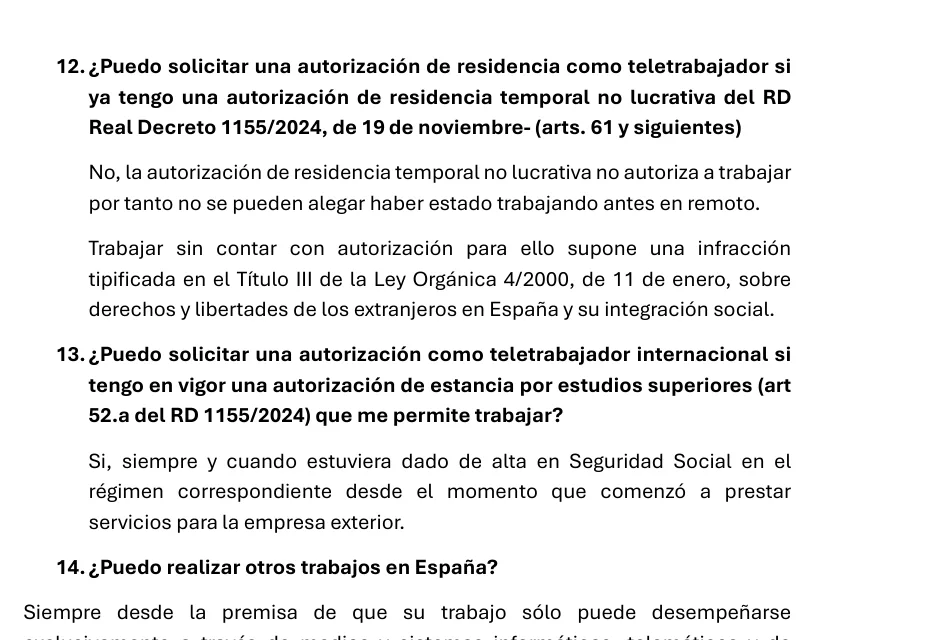
A non-lucrative residence holder cannot count remote work done under that permit: the permit does not authorise working. Planning to live in Spain without working? See the non-lucrative visa requirements.
How much income do you need in 2026?
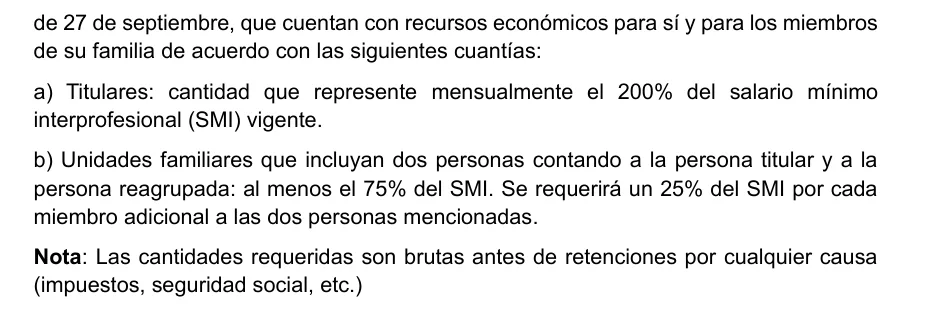
The holder needs an amount representing 200% of the current SMI each month. The amount is gross, before taxes and Social Security. The 2026 SMI is €1,221 a month, paid in 14 instalments for €17,094 a year. Read per payment, the holder needs €2,442 a month; read as the yearly SMI spread evenly across the year, €2,849.
Plan on €2,849 a month. The rule is written as a percentage, not a euro amount, so the higher reading is the safer figure to show. If your income sits between the two figures, ask the consulate or the UGE which reading it applies, and keep the answer in writing.
For family, the amount reads as follows.
b) Unidades familiares que incluyan dos personas contando a la persona titular y a la persona reagrupada: al menos el 75% del SMI. Se requerirá un 25% del SMI por cada miembro adicional a las dos personas mencionadas.
b) Family units that include two people counting the holder and the reunited person: at least 75% of the SMI. 25% of the SMI is required for each additional member beyond the two mentioned.
Ministerio de Inclusión · UGE-CE, Solicitudes iniciales de teletrabajadores, Recursos económicos b)
The rule sets at least 75% of the SMI for a unit of two and 25% for each further member. In euros, 75% is €915.75 and 25% is €305.25. The wording does not say whether the 75% is added to the holder’s 200%. Ask your consulate before you file.
| Who | Ministry wording | 2026 amount |
|---|---|---|
| Holder | 200% of the SMI per month | €2,442–€2,849 |
| Family unit of two | at least 75% of the SMI | €915.75 |
| Each extra member | 25% of the SMI | €305.25 |
Prove income with payslips or invoices for the three months before you apply. Add a bank certificate in your name, stamped by the bank, for the same three months, matching the payslips or invoices.
If the contract income falls below the minimum, show savings or other liquid income that cover the difference for the whole validity of the authorisation.
Visa from abroad or permit from inside Spain?
Your route depends on where you are today. You cannot file the residence authorisation directly from abroad.
Apply from abroad: the visa
A non-resident applies for the international teleworking visa, valid for a maximum of one year. You file at the consulate covering your place of legal residence. The visa lets you live and work remotely in Spain during its validity.
A visa application is resolved within 10 working days, unless a Visa Code consultation applies. The consulate may extend the period when it asks for more documents or an interview. The consulate in Bogotá requires an NIE application at the same time as the visa. Check your own consulate’s list.
Collect the visa in person within 1 month of notification. A refusal can be appealed for reconsideration at the consulate within 1 month.
Apply from inside Spain: the permit
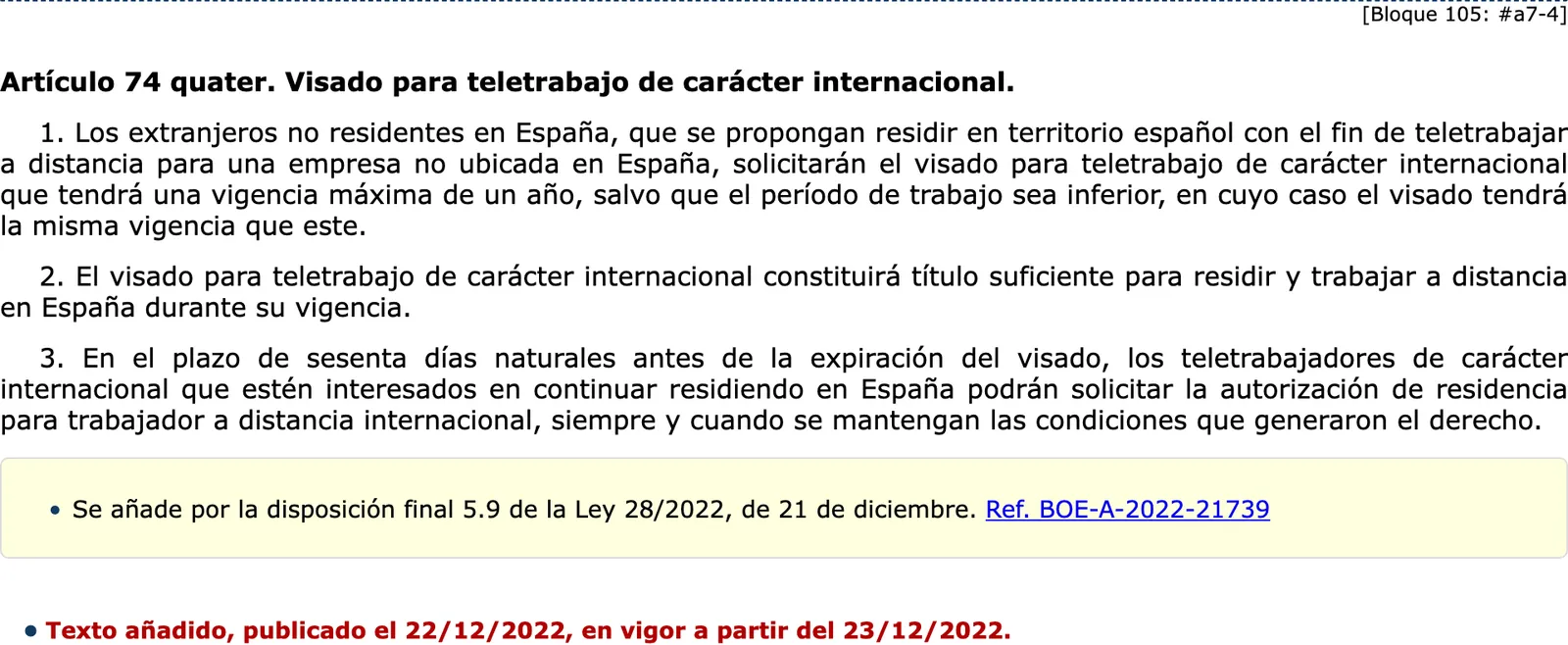
People lawfully in Spain, or who entered with the teleworking visa, may apply for a residence authorisation valid across Spain. A visa holder who wants to stay applies within the sixty calendar days before the visa expires, if the conditions still hold.
The UGE-CE (Unidad de Grandes Empresas y Colectivos Estratégicos) processes these authorisations electronically, and the Dirección General de Migraciones grants them. The maximum resolution time is twenty days from electronic filing, and if no decision comes the authorisation is deemed granted. Filing extends your existing residence or stay status until the procedure is resolved.
The legal clocks
Work backwards from the day you file. Each document has its own window, and the order you collect them in decides whether they are still valid on that day.
| Step | Limit |
|---|---|
| Work relationship with the company | at least 3 months before filing |
| Payslips or invoices, and the bank certificate | the 3 months before filing |
| Criminal record certificate (London consulate) | no older than 6 months |
| Passport (visa application) | valid at least 1 year |
| Consulate decision | 10 working days, longer if more documents or an interview are requested |
| Collect the visa | within 1 month of notification |
| Appeal a refusal | within 1 month of notification |
| Visa validity | maximum 1 year |
| Apply to stay in Spain | within the sixty calendar days before the visa expires |
| Decision on that application | twenty days, or deemed granted |
| TIE (not needed on the visa) | after a residence authorisation of more than six months, request within 1 month of the grant |
| Report a change in conditions | within 30 days |
Appointment waits, background-check processing and apostille times are not legal deadlines, so they are missing from the table. For the criminal record check and the apostille from the US or UK, use the US and UK documents guide.
Documents you need
The list for the initial application is long, so file everything in one go and add an explanatory note when a document does not match the list exactly.
Proof of your job
- The Formulario MIT, signed by you.
- A letter from the foreign company authorising work from Spain. It states your job profile, main duties, that the job can be done by telematic means, your salary in euros and the other remote-work conditions.
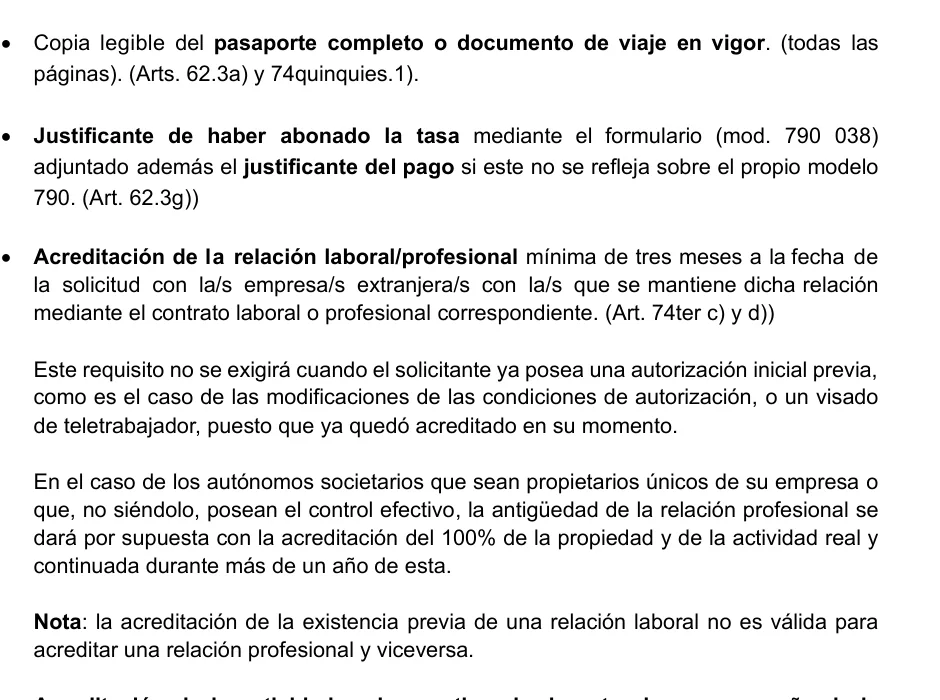
- Proof of the work relationship for at least the last three months, through the employment or professional contract.
- An official commercial-register certificate, or equivalent, showing at least one year of real and continuous activity by the company or group.
- Your CV, with a simple translation if needed.
- Your degree, or proof of at least three years of experience in similar functions.
- For a regulated profession, recognition of the Spanish equivalent qualification, or a notarised statement that you will not practise it in Spain.
Proof of income
- Payslips or invoices and a matching bank certificate for the three months before filing.
- Savings certificates if the contract income falls below the minimum.
Identity, record and fee
- A full copy of your valid passport. For the visa, the passport must be valid for at least one year and have two blank pages.
- A criminal record certificate from each country where you lived in the last two years, plus a signed self-declaration of no criminal record for the last five years.
- Proof of paying the fee on Modelo 790 código 038, with the receipt attached if the form does not show payment.
- Documents not in Spanish need a sworn translation. Foreign documents need legalisation by the issuing country’s consulate or the Hague Apostille.
The consulate in London does not accept a criminal record certificate older than 6 months unless it states a longer validity. Confirm the rule with your own consulate.
Social Security and health cover
An employee files proof that the foreign employer is registered with Spanish Social Security with no work centres in Spain. The employee also files a commitment to register in the Régimen General before starting work. A freelancer files a commitment to register as an autónomo (RETA).
An employee can replace Spanish registration with a home-country certificate only where a social security agreement exists and the certificate expressly covers work in Spain. RETA registration is mandatory for the self-employed, with no agreement substitute.
Health insurance must give cover equivalent to the Spanish National Health System. Travel insurance, reimbursement-only insurance and policies with co-payments or waiting periods are not accepted. The insurance documents are not needed when you will join Spanish Social Security after the authorisation. The public vs private healthcare guide explains the cover side.
What does it cost?
| Step | Fee | Where it is paid |
|---|---|---|
| National long-stay visa (type D) | €90 | Consulate |
| Initial residence authorisation | €73.26 | Online, before filing |
| TIE, first grant | €16.08 | Bank, Modelo 790 código 012 |
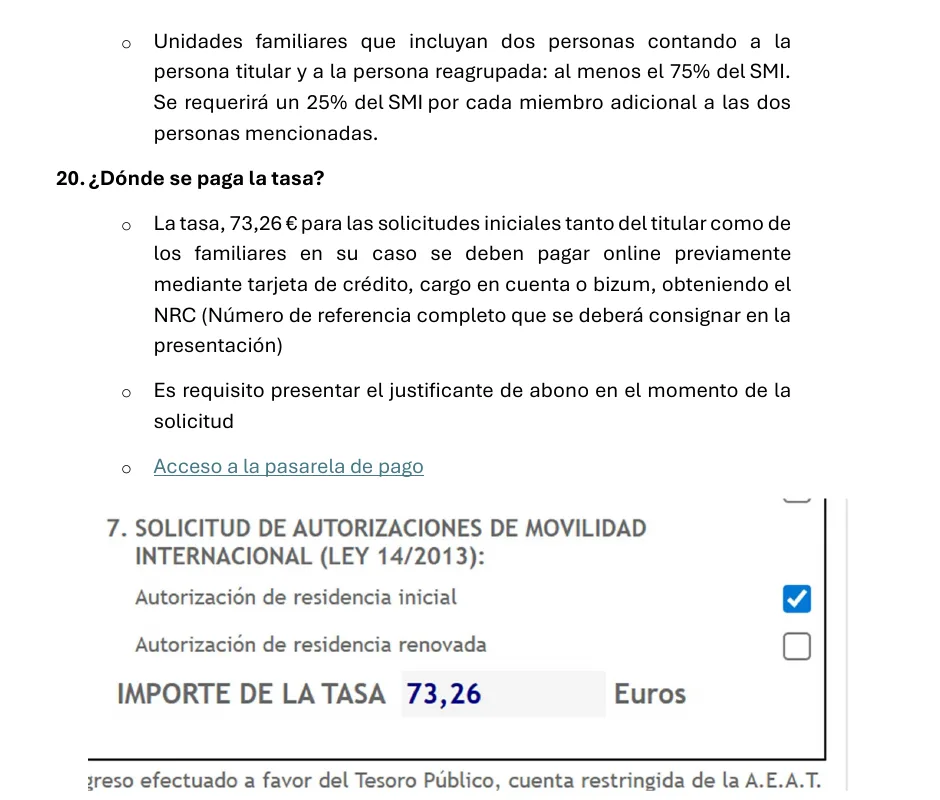
The consulate collects the visa fee in local currency, and the amount follows currency changes. Expect a figure that differs from €90. The same €73.26 authorisation fee applies to each family member filing an initial application. Pay it online by card, account debit or Bizum to obtain the NRC reference you enter at filing.
After you arrive
Register with Spanish Social Security as soon as you work from Spain. For the first six months, your passport is enough for the registration, even without an NIE. A self-employed holder who does not register can lose the authorisation, and the loss reaches dependent family members too.
A freelancer can take the resolution to a PAE (entrepreneurship support point) and ask it to process the tax and Social Security registration through CIRCE. The self-employed registration is requested before the activity starts, up to 60 calendar days before. The autónomo guide covers the steps.
Employees who hold the teleworking visa meet the employment condition of the special tax regime. Use the Beckham law guide before the six-month option deadline. The 183-day tax residency guide covers when Spain taxes your worldwide income.
Do you need a TIE in Valencia?
Not on the visa, which authorises residence without one, though you may still request it. Once your residence authorisation is granted for more than six months, request the TIE in person within one month of the grant. In Valencia city, non-EU cards are issued at the Comisaría de Patraix, calle dels Gremis 6. The Oficina de Extranjería does not issue the TIE and does not manage police appointments.
Carrer dels Gremis 6, 46014 Valencia, Spain · Open in Google Maps (opens in a new tab)
Open in Google Maps (opens in a new tab)

Police appointments run on a separate system from the Ministry’s cita previa for the Oficinas de Extranjeros. Pay the fee first, with the receipt of Modelo 790 código 012. The TIE guide for Valencia walks through the booking.
Renewal, family and what comes next
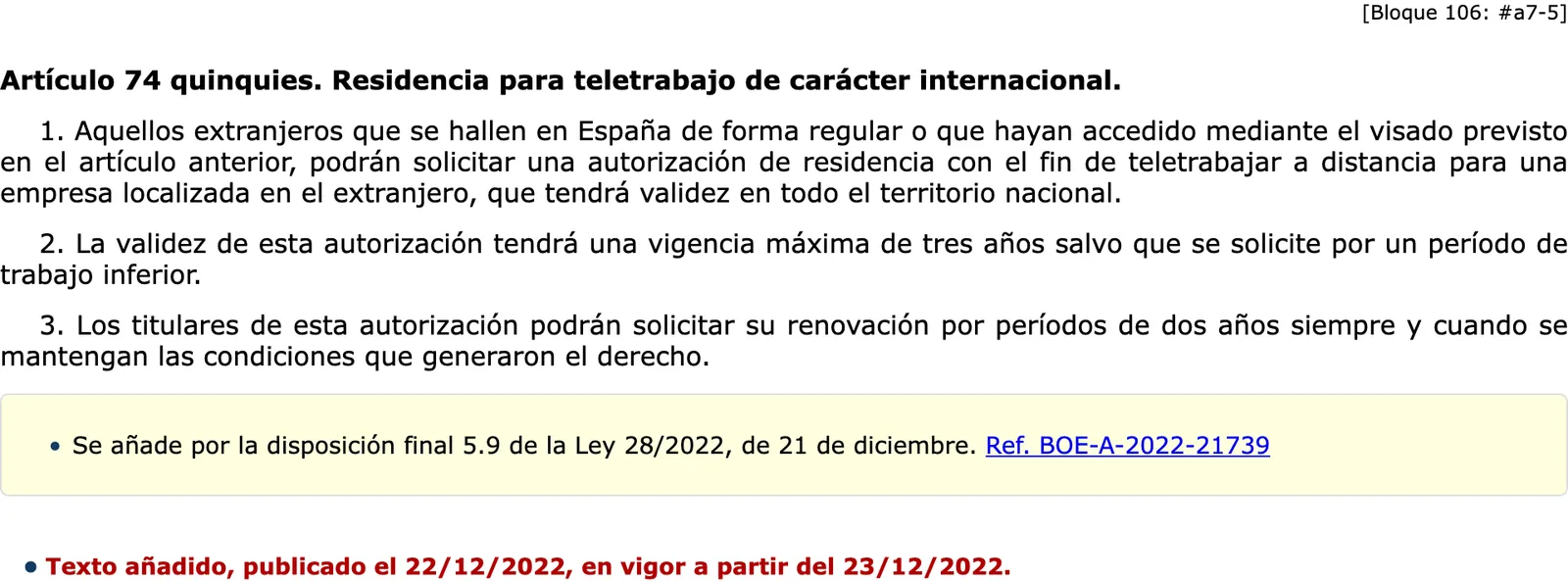
The residence authorisation lasts a maximum of three years, unless you request a shorter work period. You renew it for two-year periods while the conditions that gave you the right hold. Renewals are processed electronically.
Report any change that affects the admission conditions to the UGE-CE within 30 days. If checks show the conditions are no longer met, the competent body may extinguish the visa or authorisation, with reasons and after a hearing.
Family
A spouse or analogous partner, minor children, adult dependent children who have not formed their own family unit, and dependent ascendants may apply with you or later. Family members file proof of the fee on Modelo 790 código 038 too. They show the relationship with birth or marriage certificates from the civil registry, a partner registration certificate or other proof. Family members may work in Spain without restrictions.
Toward permanent residence
Long-term residence is a right for those who have held temporary residence in Spain for five continuous years. The permanent residency guide explains the application and the absence limits.
Where applications go wrong
- Your company is too young. The company or group must show real and continuous activity for at least one year. Wait, or document the group’s older activity.
- Documents do not match the list. Attach an explanatory note.
- Wrong insurance. Travel insurance, reimbursement-only insurance and policies with co-payments or waiting periods are not accepted. Replace it with equivalent cover.
- No Social Security registration after the grant. The authorisation can be extinguished. Register straight away.
- Freelance work for Spanish clients goes over the limit. The limit is 20% of the total professional activity. Keep Spanish work at or under it.
- Visa refused. Appeal for reconsideration at the consulate within 1 month.
Photo credits
- The town hall square in central Valencia: Zarateman, Wikimedia Commons (opens in a new tab) (CC0)
- Photos and clips uploaded to Google Maps (Policia Nacional foreigners office Valencia on Google Maps (opens in a new tab)) by Alexander.
Not confirmed: Whether the 75% family amount is added to the holder's 200%. Ask your consulate before you file. Which euro figure for 200% of the SMI your consulate applies. Ask for it in writing.
Reach readers planning life in Valencia. Advertise → hello@settlevalencia.com
Common questions
Can I apply for the digital nomad visa from inside Spain?
Not directly: you cannot file the residence authorisation from abroad. People already lawfully in Spain, or who entered on the teleworking visa, can apply for the authorisation through the UGE-CE.
How long does the application take?
About 10 working days: a consulate decides a visa application within 10 working days, unless a Visa Code consultation applies. An authorisation filed in Spain is resolved within twenty days, or it is deemed granted.
Can a freelancer work for Spanish clients?
Yes, within a limit: a self-employed holder may work for a company located in Spain, provided that work is no more than 20% of the total professional activity. An employee may work only for companies located outside Spain.
Do I need a TIE card?
Not on the visa, which authorises residence without a TIE. Once your residence authorisation is granted for more than six months, you must apply for the TIE. In Valencia the police station issues it.
Is travel insurance enough?
No. Travel insurance, reimbursement-only insurance and policies with co-payments or waiting periods are not accepted. The cover must be equivalent to the Spanish National Health System.
What if my income is below the minimum?
Cover the gap with savings: if the contract income is below the minimum, show savings or other liquid income that cover the difference for the whole validity of the authorisation. Use bank certificates in your name.
Can my family come with me?
Yes. A spouse or analogous partner, minor children, adult dependent children and dependent ascendants may apply jointly and simultaneously, or successively. Family members may work in Spain without restrictions.
Do I have to register with Spanish Social Security?
Yes. Registration is mandatory when you work from Spain: the Régimen General for employees, the autónomo regime (RETA) for the self-employed. A self-employed holder who does not register can lose the authorisation.
Read next
General information checked against the sources listed above, not legal advice for your situation. Rules and office practice change; confirm with the immigration office or a licensed adviser before you act. See how guides are checked.
Spotted an error? Report it.