Inheritance and Gift Tax in Valencia for Foreigners
Close family in the Comunitat Valenciana gets a 99% rebate on the inheritance tax quota, but only on the assets declared in the return. The return is due within six months of the death. If the person who died was not resident in Spain, the region with the largest Spanish assets sets the rules.
On this page
A parent has died, or you want to help your child buy a flat. In the Comunitat Valenciana, close family gets a 99% rebate on the tax quota. The catch is that the rebate covers only the assets you declare in the return.
Which region’s rules apply to you?
Start with where you live. If you live in Spain, the tax reaches everything you receive, wherever it is. If you do not live in Spain, it reaches goods and rights located in Spain, exercisable there or to be fulfilled there, so an heir abroad is taxed on a Valencia flat. Residence follows the income tax rules in the tax residency guide.
For a death, the rules of the community where the person who died lived apply if you live in Spain, and you can choose them if you live abroad. If the person who died was not resident in Spain, you can apply the rules of the community where the largest value of the Spanish estate lies. When a Valencia flat is the biggest Spanish asset, that means the Valencian rules. With no Spanish assets at all, you apply the rules of the community where you live.
For a gift of real estate, the rules follow the property if you are a non-resident. A resident in Spain who receives a gift of real estate also ties to the community where the property is, while a gift of cash ties to the donee’s habitual residence.
Who pays, and when
On a death, the heirs pay. On a gift, the person who receives it pays. The tax accrues on the day the person dies, or on the day the gift is made. Note that day down, because the filing period runs from it.
What takes the bill down
On a death, reductions come off the taxable base first. A descendant or adopted child under 21 gets 100.000 euros plus 8.000 euros per year under 21. The total is capped at 156.000 euros. A descendant or adopted child aged 21 or more, a spouse, an ascendant or an adopter gets 100.000 euros. A disability of 33% or more adds 120.000 euros.
The deceased’s main home gets a 95 percent reduction, up to 150.000 euros per taxpayer.
That applies if you are the spouse, an ascendant or a descendant. It also applies to a collateral relative over sixty-five who lived with them for the two years before the death. The heir must keep it for five years after the death, unless the heir dies within that period. A coefficient based on your existing wealth and kinship group then applies, so ask a gestor or notary for the exact figure before you sign anything.
The 99% rebate comes after that, and it applies to the part of the quota matching the assets you declare. It covers these cases:
- Deaths: descendants and adopted children, the spouse, ascendants and adopters.
- Gifts: the donor’s spouse, parents, adopters, children or adopted children, and also grandchildren and grandparents.
- Registered partners: treated as spouses if the Valencian conditions are met.
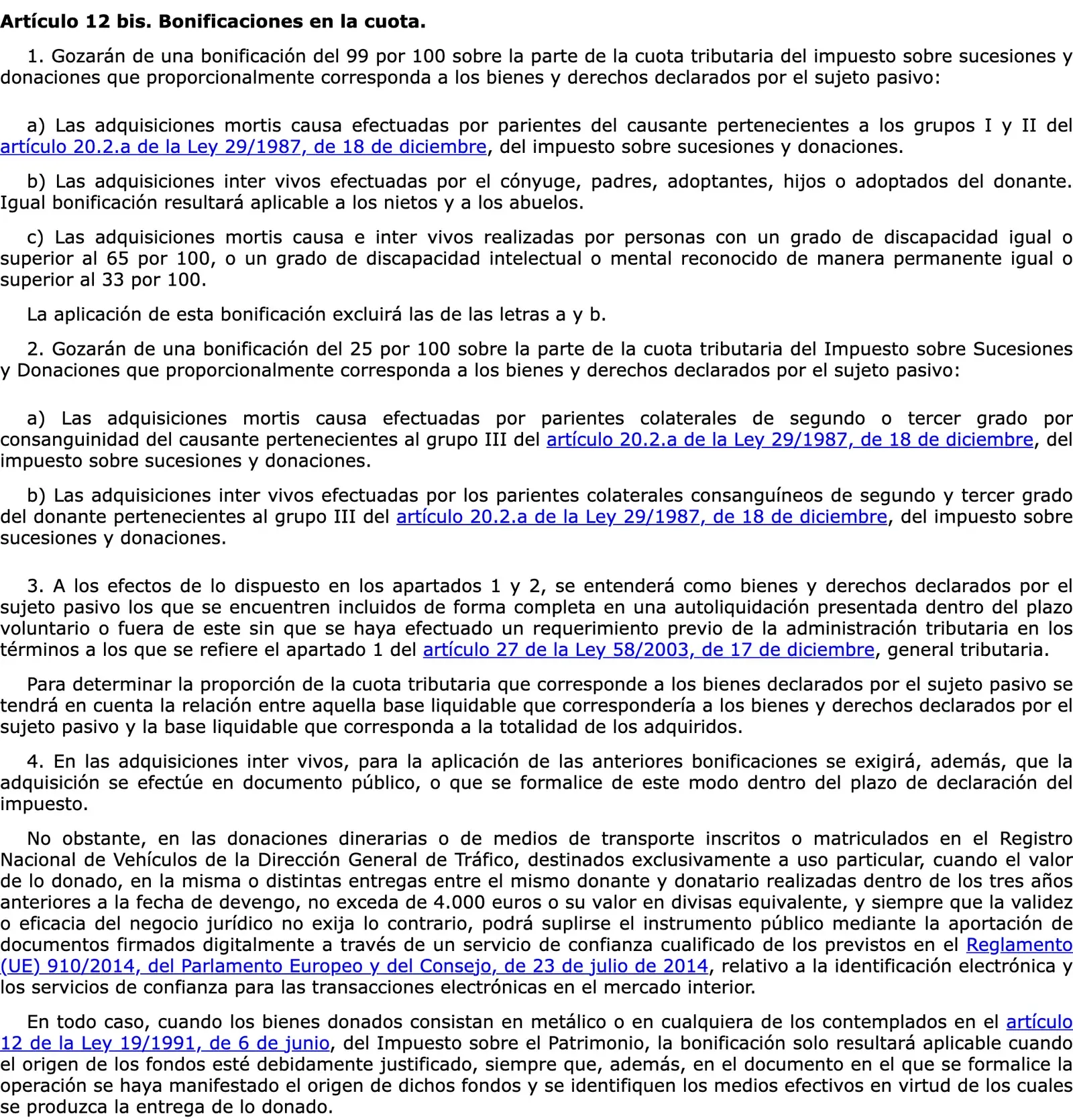
List every asset. The rebate covers assets fully included in a self-assessment filed within the voluntary period, and a later return also counts if the tax agency has not sent a prior requirement.
Siblings, uncles, aunts, nephews and nieces get a 25 percent rebate on a death today. The Valencian law sets a 50 percent rebate in a new wording from 1 June 2027; check who it covers before relying on it. Friends and other non-relatives get no reduction under the state law.
Giving your child money for a flat
A gift is taxable in its own right. Children under 21 get a reduction of 100.000 euros plus 8.000 euros per year under 21, capped at 156.000 euros. Children aged 21 or more, the spouse and parents get 100.000 euros.
The limits add up all free gifts from the same donor in the five years before the accrual. The reductions and the rebate need the gift in a public document, or put into one within the filing period. So put the gift in a notarial deed within the filing period at the latest. For a cash gift, the deed must state the origin of the funds and the means of payment. Buying the flat itself brings other taxes, covered in the guide to buying property in Valencia.
Deadline and extension
For a death, file within six months of the day of death. For a gift, the Valencian law says one month from the day the act or contract is made, while the state regulation says thirty working days. File inside the shorter period.
For a death, the tax office can grant an extension equal to the filing period. The heirs, executors or administrators must request it within the first five months, so ask in month four. A request after that gets no extension. A granted extension carries default interest until you file.
You file with the Agència Tributària Valenciana, the Valencian tax agency. Check the model number on its page before you start.
Step by step
- Work out which region's rules applyCheck where the person who died lived and where you live. For gifts of property, check where the property is.
- Note the date of the death or the giftThe tax accrues on the day of the death, or the day the gift is made. The filing period counts from that day.
- List the assets and the heirsEach heir is a taxpayer on a death. Declare every asset, because the rebate follows the assets declared.
- Decide on an extension earlyHeirs, executors or administrators must request it within the first five months.
- File the return within six monthsFile the return for a death within six months of the day of death.
Not confirmed: The page of the Agència Tributària Valenciana with the model number was not available. Whether the state extension rules apply unchanged at that agency is unconfirmed.
Common questions
Do I pay Valencian inheritance tax if the person who died lived abroad?
If the person who died was not resident in Spain, you can apply the rules of the community where the largest value of the Spanish estate lies. If nothing is in Spain, you apply the rules of the community where you live.
How much do children pay on an inheritance in Valencia?
Children get a 99% rebate on the part of the quota that matches the assets declared. Reductions of 100.000 euros or more come off the taxable base first.
What do siblings, uncles and nephews get?
A 25% rebate on a death today. A new wording from 1 June 2027 sets 50%, so check who it covers before relying on it.
Is my registered partner treated like a spouse?
Yes, if the partnership meets the Valencian conditions and is registered in the Valencian registry or in a similar registry in Spain, the EU or EEA, or a third country.
How long do I have to file after a death?
Six months from the day of the death. For a gift the Valencian law gives one month from the day the act or contract is made.
Can I get more time to file?
The tax office can grant an extension equal to the filing period for a death. Request it within the first five months.
Does a gift to my child for a flat pay tax?
Children get the 99% rebate on gifts, but it needs the gift in a public document or put into one within the filing period. A cash gift needs the funds' origin stated in it.
Read next
Sources and reader comments
Official legal texts (BOE, DOGV, government portals):
- Ley 13/1997, de 23 de diciembre, de la Generalitat, tramo autonómico del IRPF y restantes tributos cedidos, arts. 10 to 12 quáter (BOE consolidated text, last update published 10/08/2026) (opens in a new tab)
- Real Decreto 1629/1991, de 8 de noviembre, Reglamento del Impuesto sobre Sucesiones y Donaciones (BOE consolidated text, last update published 05/04/2023) (opens in a new tab)
- Ley 29/1987, de 18 de diciembre, del Impuesto sobre Sucesiones y Donaciones (BOE consolidated text, last update published 28/12/2022) (opens in a new tab)
- Ley 22/2009, de 18 de diciembre, sistema de financiación de las Comunidades Autónomas de régimen común, art. 32 (BOE consolidated text, last update published 29/07/2022) (opens in a new tab)
General information checked against the sources listed above, not legal advice for your situation. Rules and office practice change; confirm with the immigration office or a licensed adviser before you act. See how guides are checked.
Spotted an error? Report it.
Comments (0)
Be the first to ask about this topic.