Modelo 210 Imputed Income: Non-Resident Property Tax
If you are an individual living outside Spain, a Valencia home you leave empty or use yourself carries imputed income, and you file Modelo 210 for it. The base is 2% of the cadastral value, or 1.1% in some municipalities, taxed at 19% for residents of the EU, Iceland, Norway or Liechtenstein and 24% for others.
On this page
- Do you have to file for an empty flat? Short answer: yes
- How much imputed income tax will you pay?
- Which tax rate applies to you?
- When is the deadline for imputed income?
- Who can file for you, and do you need a representative?
- How do you pay from abroad?
- Renting out, buying or inheriting: what changes?
- Step by step
- Common questions
You own a flat in Valencia but live somewhere else, and nobody pays you rent. This page walks you through the return you still owe as an individual owner: how the tax is worked out, when it is due, who files for you and how you pay. If you stay in Spain for more than 183 days a year you are in a different system, so start with the 183-day residency guide and the resident versus non-resident comparison.
Do you have to file for an empty flat? Short answer: yes
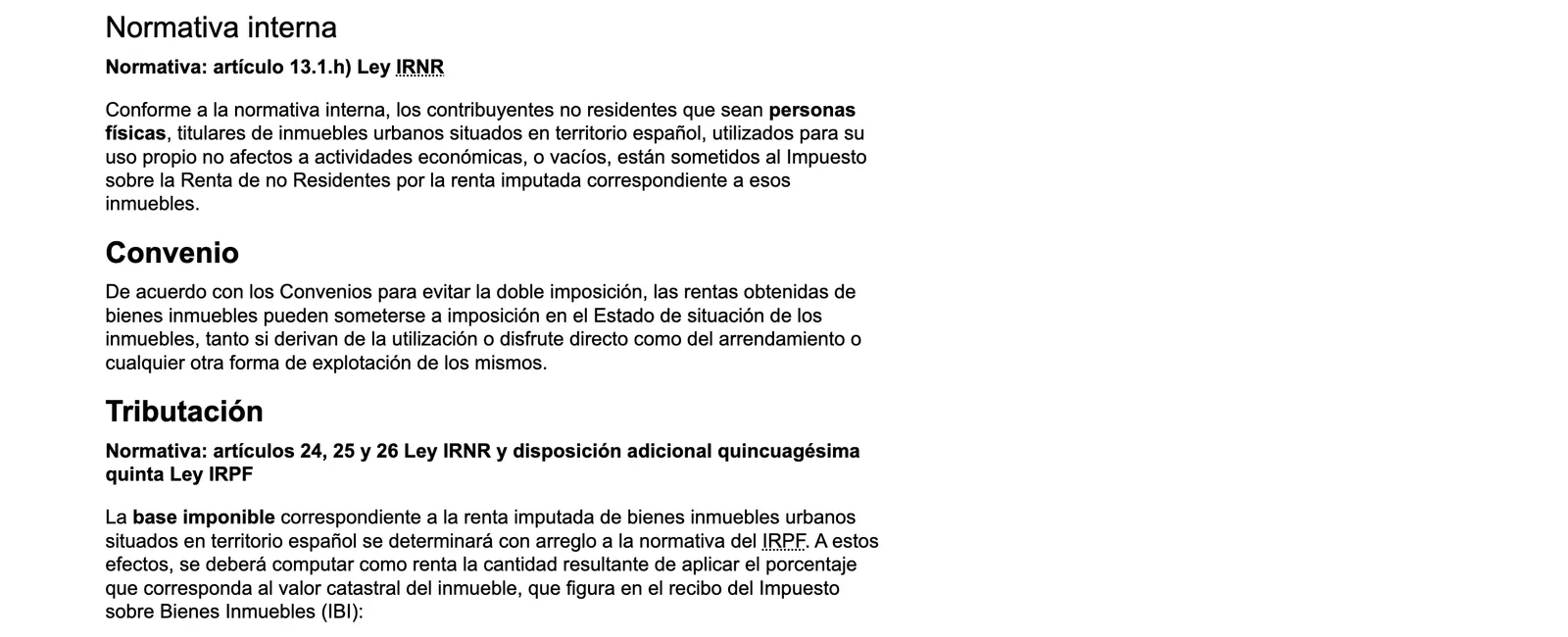
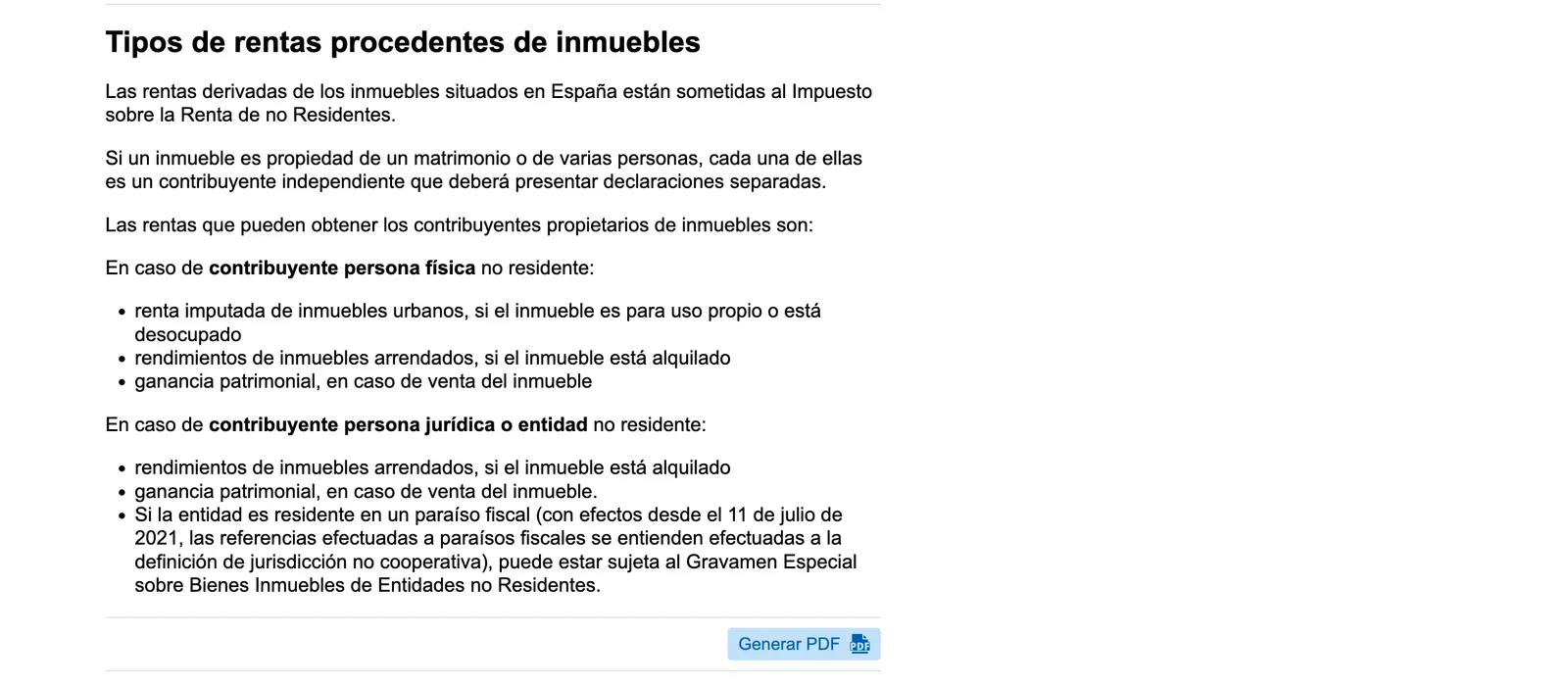
Yes, if you are an individual: a home you leave empty or use yourself counts as imputed income, and you still file Modelo 210. Imputed income is a percentage of the property’s cadastral value, and rental income is a separate type. The law counts it as income obtained in Spain by individual owners of urban property not used in an economic activity.
h) Las rentas imputadas a los contribuyentes personas físicas titulares de bienes inmuebles urbanos situados en territorio español no afectos a actividades económicas.
h) Income imputed to individual taxpayers who own urban real estate located in Spanish territory not used in economic activities.
BOE · Real Decreto Legislativo 5/2004, art. 13.1.h
The duty to file stays even when no one withholds anything, and the tax accrues on 31 December of each year. One test for tax residence is staying more than 183 days in the calendar year in Spain, so this page is for you if you are not resident. Form 210 is the single form for income, capital gains and imputed income from real estate, which means the same form covers rent or a sale later.
How much imputed income tax will you pay?
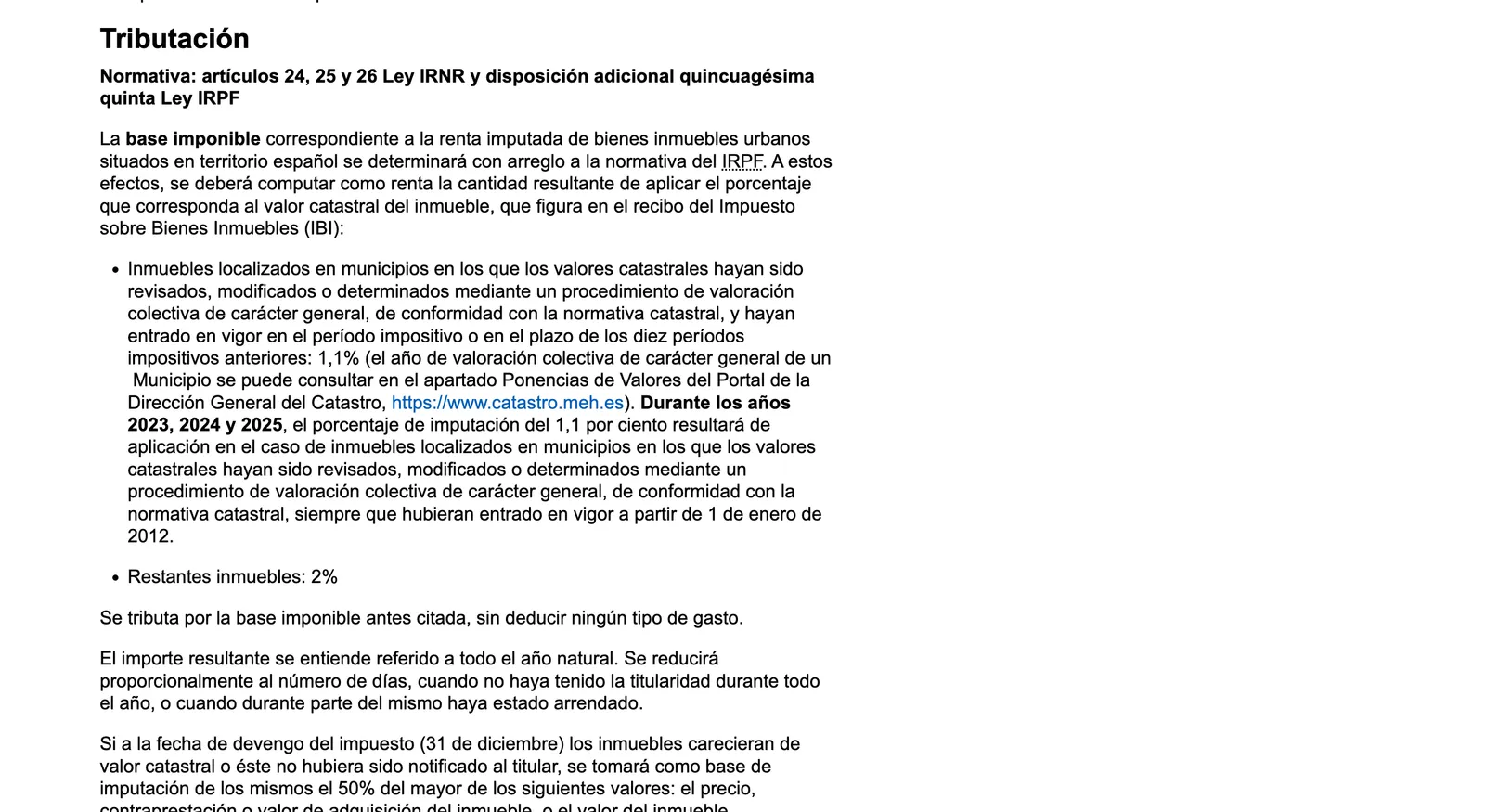
Start with the cadastral value printed on your IBI receipt, apply a percentage to it, shrink the result for the days you did not own the flat, then apply your rate. The percentage is 2% for most properties and 1.1% in municipalities with a recent general revaluation.
- Find the cadastral value on your IBI receipt.
- Apply the percentage: 2% for the remaining properties, or 1.1% where the revaluation rule below applies.
- Cut the amount in proportion to the days you did not own the property, or when it was rented.
- Apply your rate, 19% or 24%, from the next section.
- Pay on that base without deducting any type of expense.
Which percentage applies to a València flat?
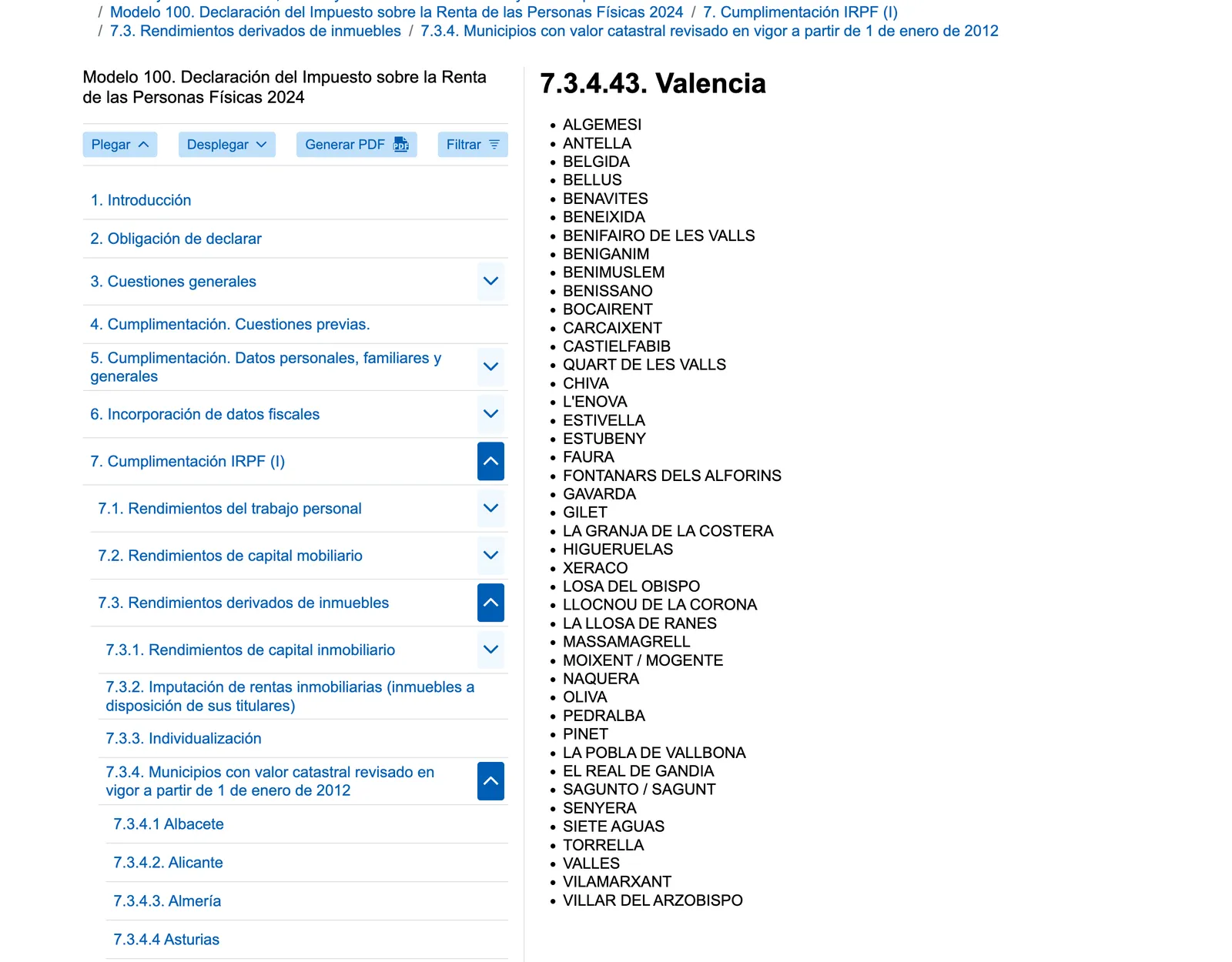
For a flat in the city of València, expect the 2%: the Tax Agency list of Valencia-province towns with revised values does not include València. The 1.1% belongs to municipalities whose revised cadastral values came into force in the tax period or the ten before. For 2023, 2024 and 2025 it also covers municipalities whose revised values came into force from 1 January 2012.
Towns such as Sagunt, Oliva and Massamagrell are on that Tax Agency list. If your flat is elsewhere, look up your municipality’s valuation year in the valuation reports section of the Catastro portal.
If the flat has no cadastral value yet
A newly built or newly registered flat may have no cadastral value, or none notified to you, on 31 December. In that case the base is 50% of the greater of the purchase price and the value the administration checked for other taxes, and the percentage is 1.1%. A property under construction, or one that cannot be used for urban planning reasons, gets no imputed income.
Could the percentage change?
The 1.1% rule is written for the tax periods 2023 to 2026, the 2026 extension comes from Real Decreto-ley 29/2026 with effect from 1 January 2026, and the same decree-law changes the imputed-income article from 1 January 2027. An earlier decree-law on the same provision was repealed by Congress, so we recommend rereading the Tax Agency page before you file for 2026.
Which tax rate applies to you?
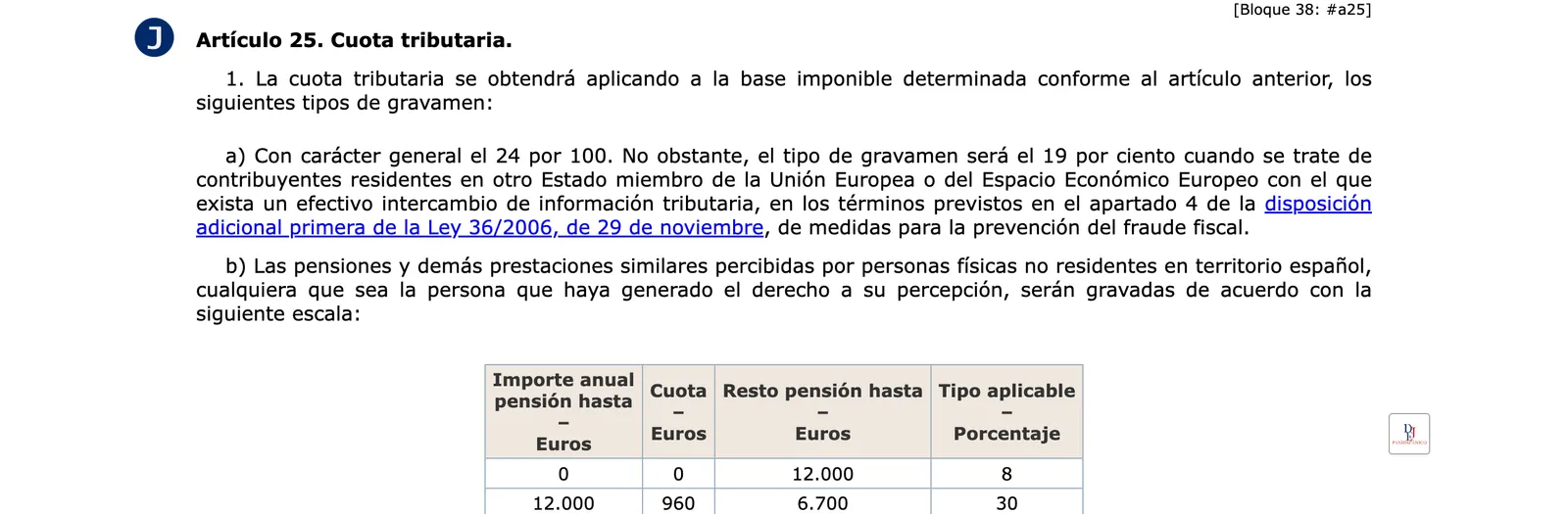
You pay 19% if you live in the EU, Iceland, Norway or Liechtenstein, and 24% if you live anywhere else. The law sets the general rate at 24%, with 19% for residents of another EU or EEA state that has effective exchange of tax information.
No obstante, el tipo de gravamen será el 19 por ciento cuando se trate de contribuyentes residentes en otro Estado miembro de la Unión Europea o del Espacio Económico Europeo con el que exista un efectivo intercambio de información tributaria
However, the rate is 19 per cent for taxpayers resident in another Member State of the European Union or of the European Economic Area with which there is effective exchange of tax information.
BOE · Real Decreto Legislativo 5/2004, art. 25.1.a)
If you live in the UK, you pay 24% on imputed income from property. The UK-Spain double taxation treaty still applies, and treaties allow the country where the property stands to tax income from it.
When is the deadline for imputed income?
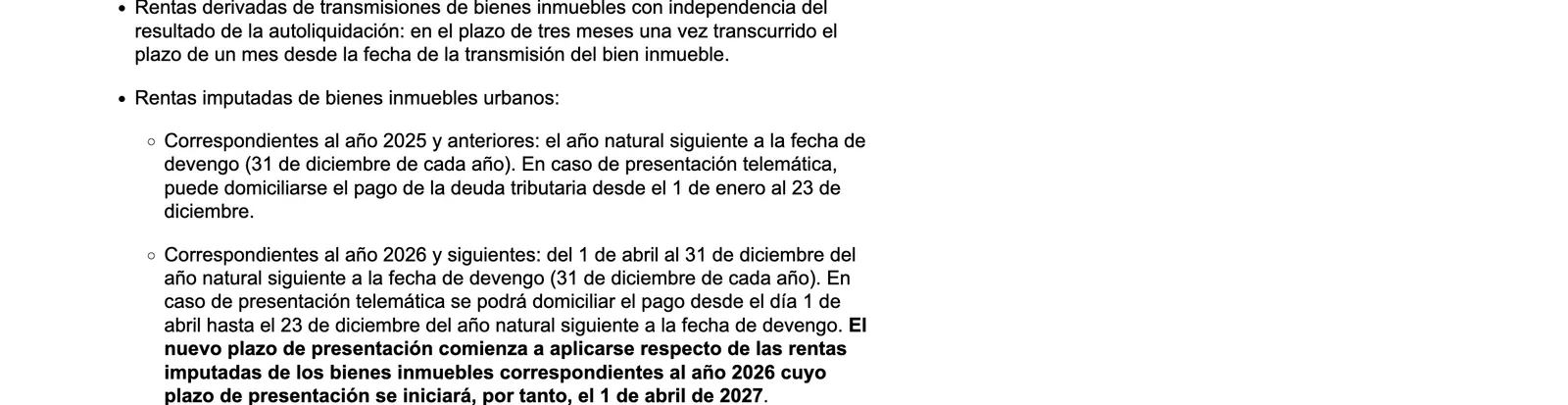
For 2025, you file between 1 January and 31 December 2026. From 2026 income onwards, the period moves to 1 April to 31 December of the following year, and the first one opens on 1 April 2027.
| Imputed income for | Filing period | Direct debit possible |
|---|---|---|
| 2025 and earlier | The calendar year after the accrual date | 1 January to 23 December |
| 2026 and later | 1 April to 31 December of the following year | 1 April to 23 December |
Checked November 2026.
Direct debit stops on 23 December while the filing period runs to 31 December, so in the last week pay with an NRC or a transfer. From returns filed on 1 January 2027, Form 210 also asks for the number of days the property was at your disposal and your share of ownership.
Who can file for you, and do you need a representative?
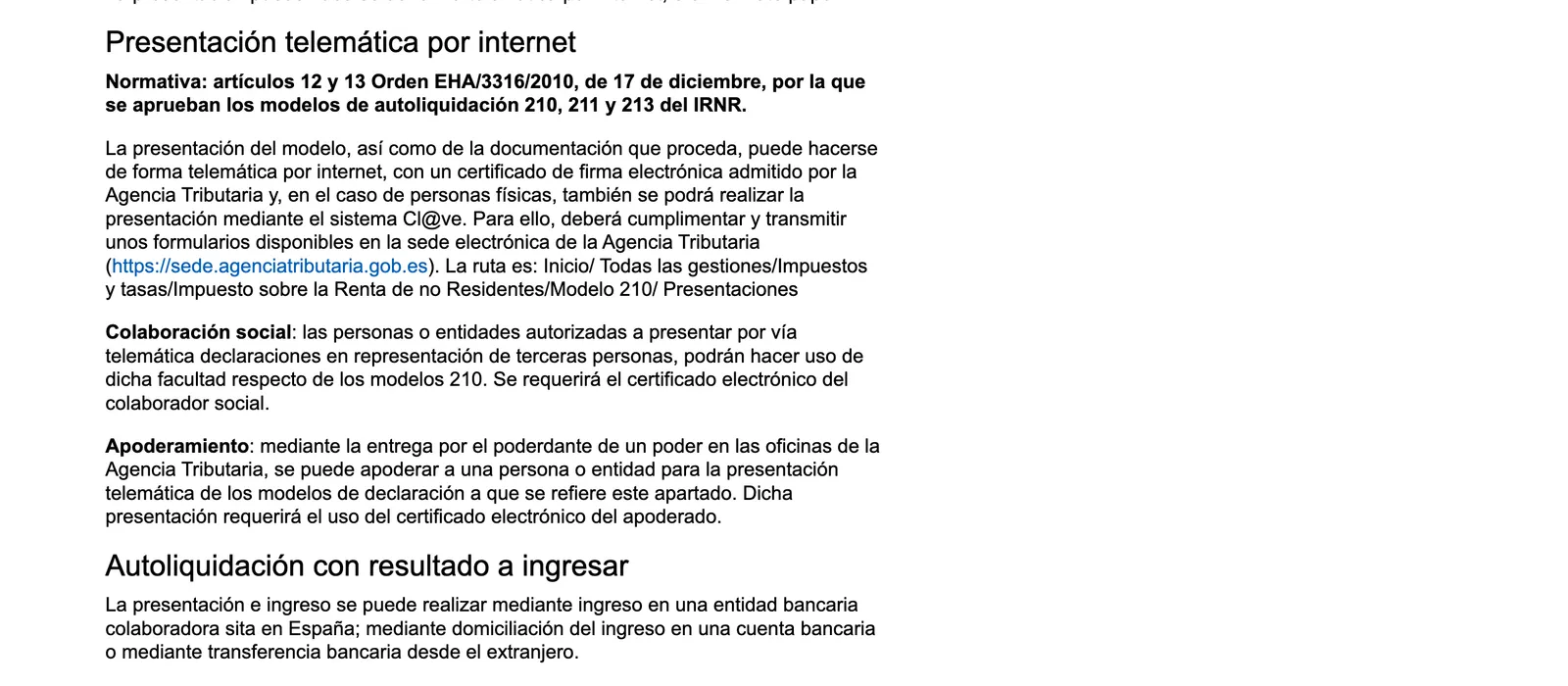
You can file it yourself online with an electronic certificate or Cl@ve, or authorise someone to file for you. Paper is also allowed, by printing the form you completed on the Tax Agency website.
Filing it yourself
Online filing needs an electronic signature certificate accepted by the Tax Agency and, for individuals, Cl@ve also works. To get one, see our digital certificate and Cl@ve guide. If you have no Spanish tax number (NIF), the pre-declaration form has a button to obtain an identification code you assign yourself.
A social collaborator or an attorney
A person or entity authorised to file for third parties can file Form 210 for you using their own electronic certificate. You can also hand a power of attorney to a Tax Agency office so an attorney files online with their certificate. We recommend this route if you have no certificate, because both options run on the filer’s certificate, not yours. If you would rather hand the filing to a professional, our guide to hiring a gestor administrativo shows how to check one before you pay.
Do you need a representative in Spain?
Not if you live in another EU member state, or in an EEA state with mutual-assistance rules. If you live in a third country, you appoint a person or entity resident in Spain before the filing period ends when the Tax Agency requires it because of the income or because you own Spanish property.
How do you pay from abroad?
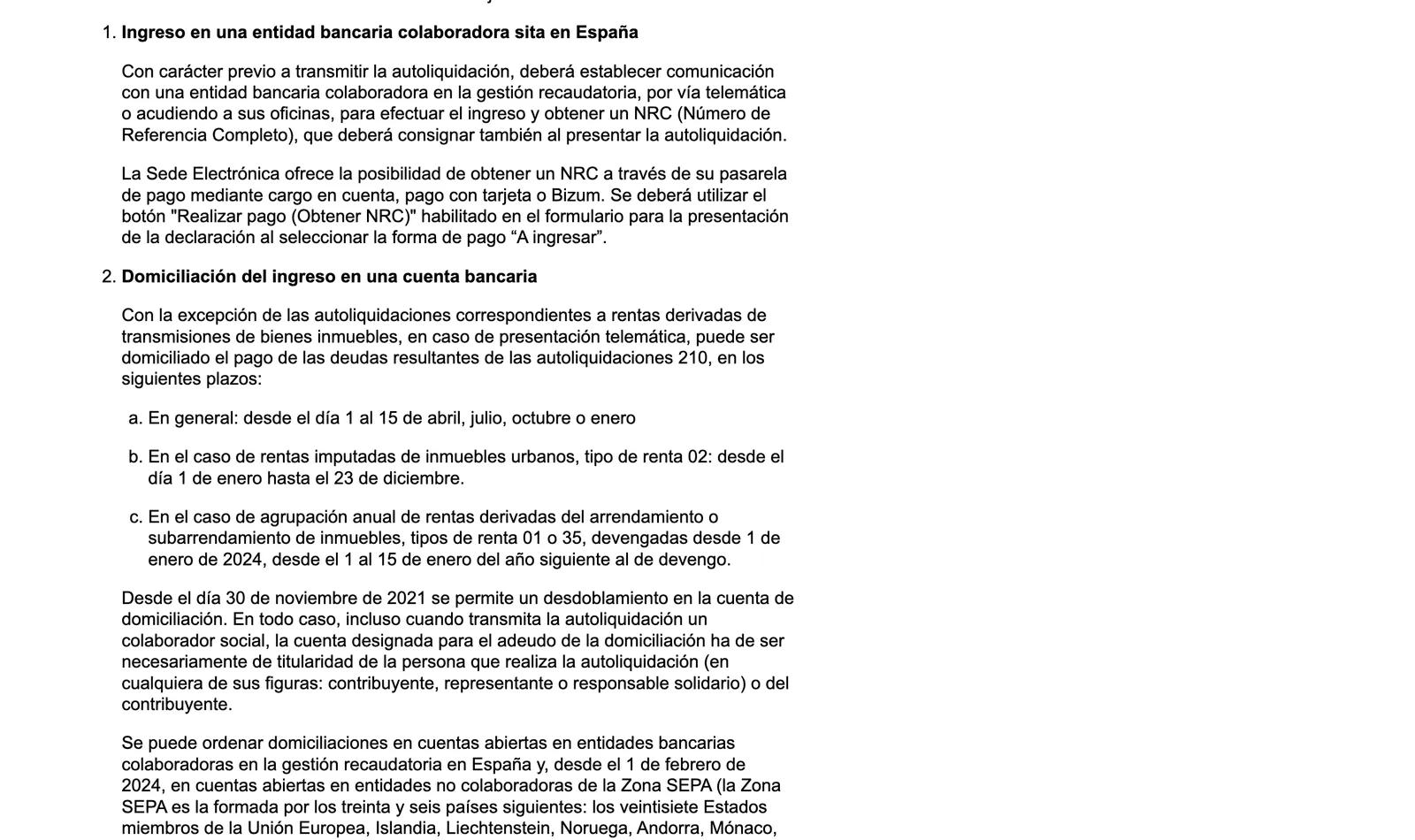
Pay at a collaborating bank in Spain, by direct debit, or by a bank transfer from abroad, which must be in euros.
Pay with an NRC
Before you send the return, you get an NRC (Número de Referencia Completo) from the bank and enter it when you file. The Tax Agency e-office can issue one through its payment gateway by account debit, card or Bizum.
Direct debit
The account must belong to you as taxpayer or to the person who files. It can be at a collaborating bank in Spain or, since 1 February 2024, at a bank in the SEPA zone that is not a collaborating bank.
Transfer from abroad
You can use a transfer if the accrual is for 2019 or later. The steps run in this order:
- File online, choosing the payment method “Reconocimiento de deuda y pago mediante transferencia”.
- Take the IBAN the system shows and the payment identifier, which is valid for 30 calendar days.
- Put the identifier in the transfer concept field, and send euros.
- Download your proof of payment from the e-office once the bank has confirmed receipt.
A transfer without a valid identifier, or in another currency, is returned to you at your own cost.
Renting out, buying or inheriting: what changes?
The type of income follows what you do with the flat: imputed income if it is for your own use or empty, rental income if it is rented, and a capital gain if you sell. All three go on Form 210.
If you rent it out
The imputed amount is reduced for the days the flat was rented, and the rent itself goes on Modelo 210. Rental income accrued from 2026 and grouped for the year is filed from 1 to 20 April of the following year. EU and EEA residents who are individuals may deduct expenses directly linked to the income obtained in Spain, while the general base is the gross amount with no expense deducted and UK residents cannot use that deduction.
If you just bought it
You declare the part of the year you owned it. The Tax Agency’s own example is a German resident who buys a property on 1 April 2026 for own use: he declares 9 months of 2026 between 1 April and 31 December 2027. Our guide to buying property in Valencia covers the purchase itself.
If you inherited it
Income subject to Inheritance and Gift Tax is not subject to this tax, so the inheritance itself is not income for this return. The imputed income of the years you own the home does. The inheritance and gift tax guide covers the other tax.
If you sell it
The same Form 210 covers the capital gain, and when you sell, the buyer must withhold and pay in 3% of the agreed price. The details of a sale go beyond this page.
If you co-own it
Each co-owner is a separate taxpayer who files a separate return, and the income counts for each in proportion to their share.
If you later move to Spain, the guide to the foreign-asset return and the income tax return calendar cover what comes next.
Step by step
- Confirm you are not tax residentOne test for tax residence is staying more than 183 days in the calendar year.
- Find the cadastral valueIt appears on your IBI receipt.
- Apply the percentageUse 2% for most properties and 1.1% in municipalities with a recent general revaluation.
- Reduce it for the days you did not own it or rented itThe result refers to the whole calendar year and falls in proportion to those days.
- Apply your rateThe rate is 19% for residents of the EU, Iceland, Norway or Liechtenstein, and 24% for others.
- File and pay the returnFile online with a certificate or Cl@ve, or through an authorised person, and pay with an NRC, direct debit or a transfer in euros from abroad.
Not confirmed: Whether Real Decreto-ley 29/2026 is confirmed: it extends the 1.1% rule to 2026 and changes the imputed-income rule from 2027, but Congress repealed an earlier decree-law on the same provision, so check the BOE before you file for 2026. Late-filing surcharges are not stated on the Tax Agency pages read.
Common questions
Do I still file if I only use the flat a few weeks a year?
Yes. A property for personal use gives imputed income, and Modelo 210 is the form for it. The amount is reduced in proportion to the days when it was rented or you did not own it.
Can I deduct the IBI, community fees or mortgage interest?
No. Imputed income is taxed on its base without deducting any type of expense.
My partner and I own the flat together. Do we file one return?
No. Each co-owner is a separate taxpayer and files a separate return, and the income counts for each of you in proportion to your share.
Do I need a Spanish representative to file?
Not if you live in another EU member state, or in an EEA state with mutual-assistance rules. If you live in a third country, you appoint one when the Tax Agency requires it because of the income or because you own Spanish property.
I bought the flat this year. When do I file?
For a purchase in 2026, you declare the part of 2026 you owned it, and the filing period runs from 1 April to 31 December 2027.
Does a UK address change the rate?
UK residents pay 24%, including on imputed income from property. The UK-Spain double taxation treaty still applies.
Read next
Sources and reader comments
Official legal texts (BOE, DOGV, government portals):
- AEAT sede (Spanish page): Modelo 210, modelo y plazo de declaración (reflects Orden HAC/623/2026) (opens in a new tab)
- AEAT sede (Spanish page): Renta imputada de inmueble urbano para uso propio (non-residents) (opens in a new tab)
- AEAT sede (Spanish page): Declaración del IRNR sin establecimiento permanente, obligación de declarar (opens in a new tab)
- Ley 35/2006, de 28 de noviembre, del Impuesto sobre la Renta de las Personas Físicas (BOE consolidated text, last update published 07/10/2026; art. 9 and disposición adicional 55ª) (opens in a new tab)
- AEAT sede (Spanish page): Cuestiones específicas sobre tributación de inmuebles (opens in a new tab)
Show 9 more sources
- AEAT sede (Spanish page): Representación y responsabilidad solidaria en el IRNR (opens in a new tab)
- Real Decreto Legislativo 5/2004, de 5 de marzo, Texto refundido de la Ley del Impuesto sobre la Renta de no Residentes (BOE consolidated text, last update published 25/05/2023; arts. 5, 10, 12, 13, 24, 25, 28) (opens in a new tab)
- AEAT sede: Nota modificaciones en plazos de presentación del modelo 210 introducidas por la Orden HAC/623/2026 (Spanish page) (opens in a new tab)
- AEAT sede (Spanish page): Consecuencias del Brexit en el IRNR sin establecimiento permanente (opens in a new tab)
- AEAT sede (Spanish page): Formas de presentación del modelo 210 (opens in a new tab)
- AEAT sede (Spanish page): Devengo en el IRNR sin establecimiento permanente (opens in a new tab)
- AEAT sede (Spanish page): Manual IRPF 2024, 7.3.4 Municipios con valor catastral revisado en vigor a partir de 1 de enero de 2012 (opens in a new tab)
- AEAT sede (Spanish page): Manual IRPF 2024, 7.3.4.43 Valencia, municipios con valor catastral revisado en vigor a partir de 1 de enero de 2012 (opens in a new tab)
- AEAT sede (Spanish page): Determinación de la base imponible en el IRNR sin establecimiento permanente (opens in a new tab)
General information checked against the sources listed above, not legal advice for your situation. Rules and office practice change; confirm with the immigration office or a licensed adviser before you act. See how guides are checked.
Spotted an error? Report it.
Comments (0)
Be the first to ask about this topic.