Spanish Citizenship by Residence: Years, Exams, Steps
Ten years of residence is the general rule for Spanish nationality; two years suffice for nationals of origin of Ibero-American countries, Andorra, the Philippines, Equatorial Guinea or Portugal, and for Sephardim. The residence must be legal, continuous and immediately before you apply. You must also pass the CCSE and, unless you are exempt, the DELE at level A2 or higher.
On this page
Spanish nationality by residence takes ten years of legal residence as the general rule. Some applicants need less, so find your row below before you start counting.
How many years of residence do you need?
Para la concesión de la nacionalidad por residencia se requiere que ésta haya durado diez años.
For nationality by residence, the residence must have lasted ten years.
BOE · Código Civil, art. 22.1
- Ten years is the general rule.
- Five years if you obtained refugee status.
- Two years if you are a national of origin of an Ibero-American country, Andorra, the Philippines, Equatorial Guinea or Portugal, or a Sephardic Jew.
- One year in the cases listed below.
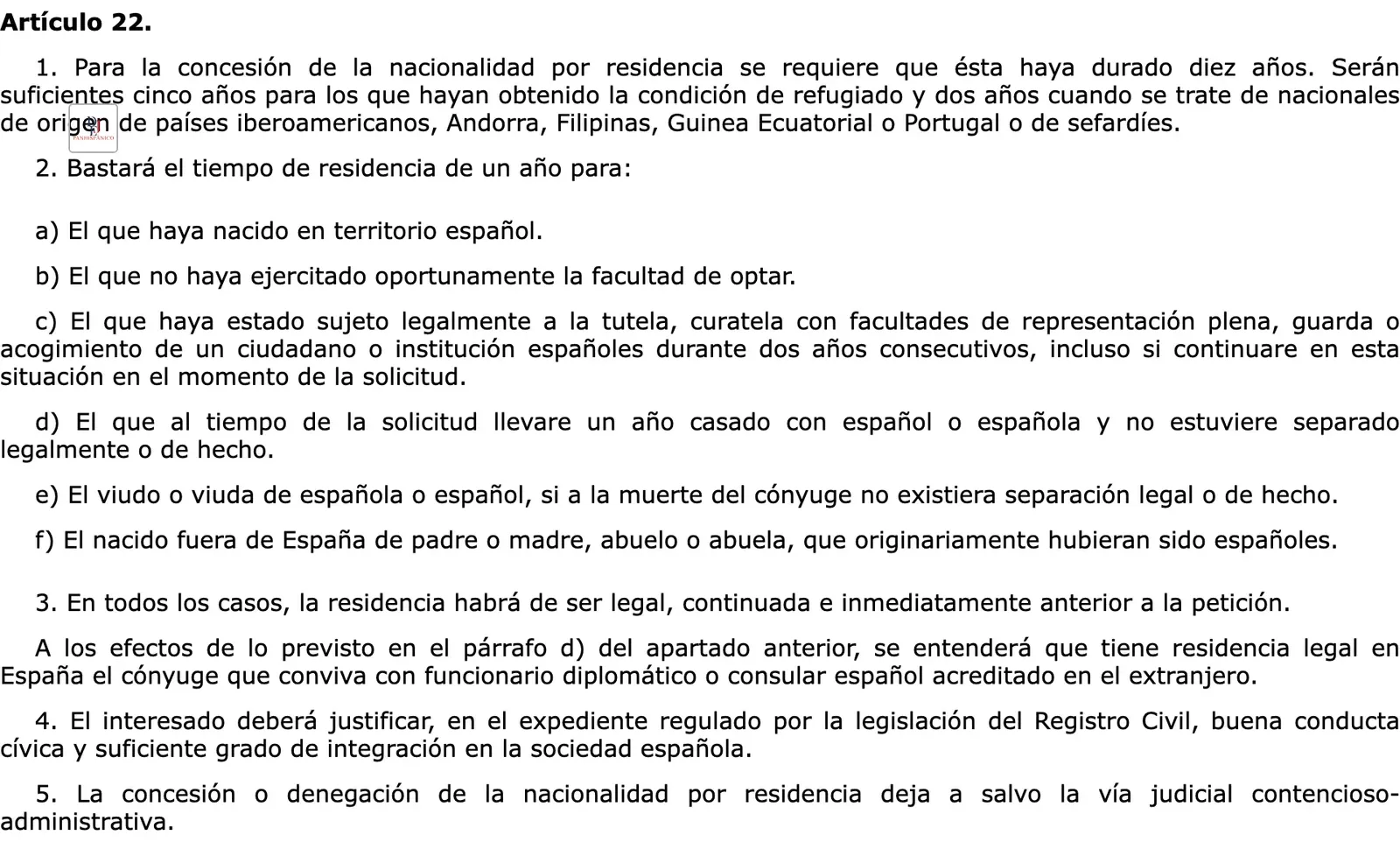
The one-year cases
- You were born in Spanish territory.
- You did not exercise the right of option in time.
- You were legally subject to the guardianship, curatorship with full powers of representation, custody or fostering of a Spanish citizen or institution for two consecutive years.
- You have been married to a Spaniard for one year when you apply and you are not separated, legally or de facto.
- You are the widow or widower of a Spaniard, and there was no separation at your spouse’s death.
- You were born outside Spain to a parent or grandparent who was originally Spanish.
If one of these applies, you also attach documents proving it, in the terms the Ministry of Justice sets.
What counts as continuous residence?
Whatever your period, the residence must be legal, continuous and immediately before the application. Renew your card before it expires so nothing breaks that chain; the renewal guide covers the steps. Permanent residence is a different clock, which asks for five years of legal and continuous residence. It has its own guide.
Which exams do you have to pass?
Two: the DELE at level A2 or higher, and the CCSE on Spain’s constitutional and sociocultural knowledge. The Instituto Cervantes runs both, in person, and can also run them remotely in the cases and on the terms it sets.
You skip the DELE if you already hold a DELE diploma at level A2 or higher. Nationals of Argentina, Bolivia, Chile, Colombia, Costa Rica, Cuba, Ecuador, El Salvador, Guatemala, Equatorial Guinea, Honduras, Mexico, Nicaragua, Panama, Paraguay, Peru, Puerto Rico, the Dominican Republic, Uruguay and Venezuela are exempt too. These exemptions cover only the DELE, not the CCSE. Note that this list differs from the two-year list: the Philippines, Portugal and Andorra are on the first but not the second.
For the pass mark, the price and how to book, see our CCSE and DELE exam guide.
The Ministry also looks for good civic conduct and a sufficient degree of integration in Spanish society. It weighs your exam results together with the reports named in article 8 of the regulation.
How do you file the application?
The whole procedure is electronic, although documents can still be submitted in any of the legally provided forms. For an electronic filing, you start on the standard form through the electronic application.
- Pass the DELE and the CCSE, or confirm that you are exempt. If you do not attach the certificates, authorise the Ministry on the form to check them in the Instituto Cervantes databases.
- Get your birth certificate from your country of origin, legalised and translated where needed. The apostille and sworn translation guide covers both.
- Have your passport ready, plus a criminal record certificate from your country of origin, legalised and translated. An EU national can replace it with the Spanish Central Criminal Record certificate stating that the home-country records were consulted.
- Pay the €100 fee on the payment form on the Ministry of Justice website. Keep the proof of payment, which is part of the application.
- File. Documents that need your signature are signed with a recognised electronic certificate of yours, of your representative or of the authorised professional. The digital certificate guide explains how to get one.
The fee is charged when you apply, whatever the outcome, and it does not include the exam prices, which the Instituto Cervantes sets. You can swap the consents to check your address, criminal record and foreigner file for the empadronamiento certificate, the Spanish criminal record certificate and your foreigner’s card. The empadronamiento guide and TIE guide cover two of them.
Once filed, you get a record of the date and time of registration. Electronic notifications must be requested or expressly consented to; otherwise they go on paper, so we recommend asking for them on the form.
How long does the decision take?
The Ministry has a maximum of one year from the day your application reaches the Dirección General. If nothing arrives by then, the application is deemed rejected. The Minister of Justice may also refuse on reasoned grounds of public order or national interest. Either way, the court route stays open.
What happens after the grant?
You have 180 days from the notification to appear before the competent official, or the grant lapses. Three things make the acquisition valid.
- You swear or promise loyalty to the King and obedience to the Constitution and the laws, if you are over fourteen and capable.
- You declare that you renounce your previous nationality.
- The acquisition is entered in the Spanish Civil Registry.
Do you have to give up your passport? The law asks for the renunciation declaration, but natives of the countries named in paragraph 1 of article 24 and Sephardim originating from Spain are exempt. Ask your home country’s consulate how it treats the renunciation before you file.
Step by step
- Check which residence period applies to youTen years is the general period. Two years apply to nationals of origin of the listed countries and to Sephardim, and one year to the cases in article 22.2.
- Pass the DELE and the CCSE, or confirm an exemptionBoth exams are run by the Instituto Cervantes. The DELE exemption covers holders of a DELE A2 diploma and nationals of the listed countries.
- Collect your documentsYou need a birth certificate from your country of origin, your passport and a criminal record certificate.
- Pay the fee on the Ministry's formThe payment form is on the website of the Ministry of Justice. Keep the proof of payment for the application.
- File electronicallyFile on the standard form through the electronic application. Keep the record of the date and time of registration.
Not confirmed: The tax code printed on the Ministry's payment form is not confirmed; the Ministry publishes the form. The Instituto Cervantes prices of the DELE and CCSE are not confirmed. How long the Ministry takes in practice is not confirmed; only the legal maximum is.
Common questions
Can I apply for Spanish nationality after five years of residence?
Only if you obtained refugee status. Otherwise it is ten years, unless a two-year or one-year case applies. Five years of legal and continuous residence also give you a national long-term residence authorisation, which is a different status.
Do I have to give up my current passport?
The law asks you to declare that you renounce your previous nationality. Natives of the countries named in paragraph 1 of article 24 and Sephardim originating from Spain are exempt. Ask your home country's consulate how it treats the renunciation.
Do I have to take the DELE and the CCSE?
Yes, both. You skip the DELE if you hold a DELE diploma at level A2 or higher, or if you are a national of one of the listed countries. These exemptions cover only the DELE, not the CCSE.
Where do I file the application?
Online, through the Ministry of Justice's electronic application, using the standard form. You get a record of the date and time it was registered.
How long do I have to take the oath after the grant?
The grant lapses 180 days after it is notified if you do not appear before the competent official. That visit covers the oath, the renunciation and the Civil Registry entry.
Does time as a student or on a temporary permit count?
The residence must be legal, continuous and immediately before the application. The Código Civil does not list which permits count, so ask the Ministry of Justice before you file.
Read next
Sources and reader comments
Official legal texts (BOE, DOGV, government portals):
- Código Civil, Real Decreto de 24 de julio de 1889, arts. 21 to 23 (BOE consolidated text; art. 22 last modified 03/06/2021, art. 23 last modified 25/06/2015) (opens in a new tab)
- Real Decreto 1004/2015, de 6 de noviembre, Reglamento del procedimiento para la adquisición de la nacionalidad española por residencia (BOE-A-2015-12047, consolidated text, last update published 10/09/2024) (opens in a new tab)
- BOE consolidated text: Real Decreto 1155/2024, de 19 de noviembre, Reglamento de la Ley Orgánica 4/2000 (last update 22/09/2026 per BOE) (opens in a new tab)
- Ley 19/2015, de 13 de julio, de medidas de reforma administrativa en el ámbito de la Administración de Justicia y del Registro Civil, disposición final séptima (BOE-A-2015-7851, consolidated text, last update published 14/07/2015) (opens in a new tab)
General information checked against the sources listed above. Prices, opening hours and other details change; confirm them with the provider before you act. See how guides are checked.
Spotted an error? Report it.
Comments (0)
Be the first to ask about this topic.