Spanish Will for Foreigners in Valencia: Law and Notary
Unless you choose otherwise, the law of the state where you had your habitual residence at the time of death governs the whole succession. In your will you can instead choose the law of a state whose nationality you hold. A Spanish open will is made before a notary, who reads it aloud before you sign.
On this page
You bought a flat in Valencia, and your will is still the one you signed back home. Living in Spain changes the default. Unless you choose otherwise, the law of the state where you had your habitual residence at the time of death governs your whole estate. If that is Spain, Spanish law applies.
Which country’s law governs your estate?
Do not count on the exceptions. Another state’s law governs only when all the circumstances clearly show that, at death, you were manifestly more closely connected with that state. The law the rules designate applies even when it is not the law of an EU member state.
Can you choose your home country’s law?
Yes, in the will itself. You can designate the law of the state whose nationality you hold at the time of the choice or at the time of death. With several nationalities, you can choose the law of any of those states.
The choice must be made expressly in the will, or follow from its terms. A clause of its own leaves nobody arguing about what you meant. The chosen law governs the substantive validity of the act by which you made the choice. If you change your mind, the change or revocation must meet the formal requirements that apply to changing or revoking a will. Ask the notary what the choice means for your heirs before you decide.
How do you make the will?
A Spanish open will (testamento abierto) is made before a notary entitled to act in the place where you sign. The notary attests that they know you or have identified you properly. Here is how the visit goes:
- Tell the notary your last wishes, orally, in writing or by any technical, material or human means.
- The notary drafts the will and warns you of your right to read it yourself.
- The notary reads the will aloud so you can say whether it matches your wishes.
- If it does, you sign on the spot, together with any witnesses and other persons who must attend.
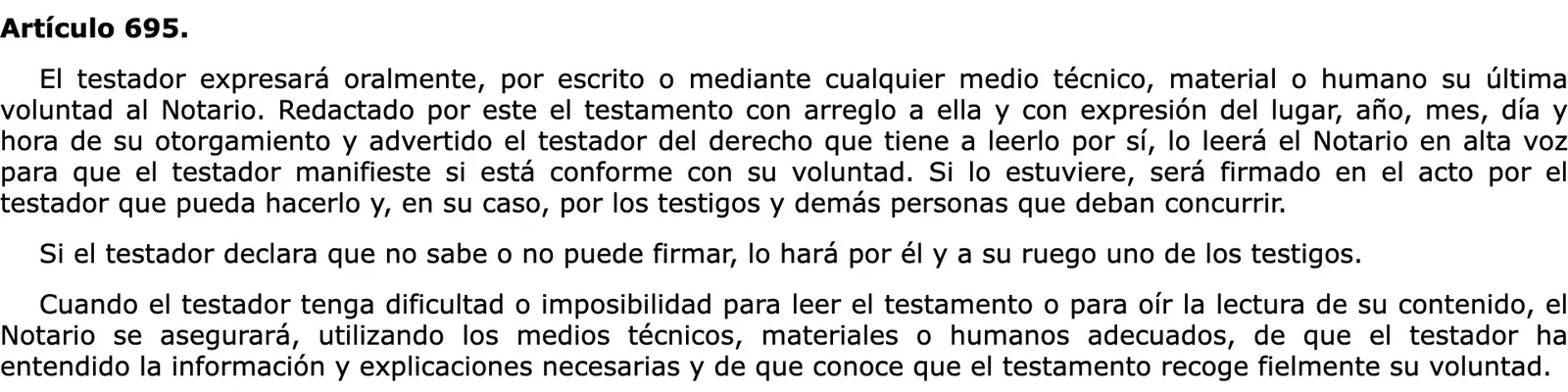
Two suitable witnesses attend when you say you cannot sign, or when you or the notary ask for them. If an interpreter translated your wishes into the official language the notary uses, the interpreter must also attend. We recommend agreeing with the notary beforehand on who will interpret.
A person in imminent danger of death can make a will before five suitable witnesses, without a notary. That will becomes ineffective if two months pass after the person is out of danger of death.
After you sign
Your heirs will need proof of your last will. The Ministry of Justice keeps the Registro General de Actos de Última Voluntad, and the certificado de últimas voluntades is requested from it. Its current form, fee and waiting time are on the Ministry’s page. Tell your heirs where the will is and which notary holds it.
The will decides who inherits, and the tax is a separate step for your heirs. On a death, the people who inherit are the taxpayers. The tax accrues on the day of death, and the return is due within six months of that day. Our inheritance and gift tax guide covers the Valencian rebates and the filing steps.
Residence changes what is taxed. A taxpayer whose habitual residence is in Spain pays on the assets acquired, wherever they are. A taxpayer not resident in Spain pays on goods and rights located in, exercisable in or to be fulfilled in Spanish territory. If you own your flat, see also the property buying guide.
Step by step
- Decide whether to choose your nationality's lawWithout a choice, the law of your habitual residence at death applies. A choice must be made expressly in the will, or follow from its terms.
- Book a notaryAn open will is made before a notary entitled to act in the place where you sign.
- Tell the notary your wishesYou can do it orally, in writing or by any technical, material or human means.
- Listen to the reading and signThe notary reads the will aloud so you can say whether it matches your wishes. If it does, you sign on the spot.
- Tell your heirs about the tax deadlineOn a death, the return must be filed within six months of the day of death.
Not confirmed: The form, fee and waiting time of the certificate of last wills are not confirmed. Notary fees for a will are not confirmed either.
Common questions
Which country's law governs my estate if I live in Valencia?
Unless you choose otherwise, the law of the state where you had your habitual residence at the time of death governs the whole succession. Exceptionally, the law of a state with a manifestly closer connection applies instead.
Can I choose my home country's law in a Spanish will?
You can designate the law of the state whose nationality you hold, at the time of the choice or at death. The choice must be made expressly in the will, or follow from its terms.
Can I change the choice of law later?
A change or revocation of the choice must meet the formal requirements that apply to changing or revoking a will. Ask the notary how to do it.
Do I need a notary and witnesses?
An open will is made before a notary. Two suitable witnesses attend when you say you cannot sign, or when you or the notary ask for them. In imminent danger of death, a will can be made before five suitable witnesses, without a notary.
What if I do not speak the notary's language?
If an interpreter translated your wishes into the official language the notary uses, the interpreter must attend the signing. The notary reads the will aloud so you can say whether it matches your wishes.
Who pays the inheritance tax after I die?
On a death, the people who inherit are the taxpayers. The tax accrues on the day of death, and the filing period is within six months of that day.
Read next
Sources and reader comments
Official legal texts (BOE, DOGV, government portals):
- Reglamento (UE) n.º 650/2012 del Parlamento Europeo y del Consejo, de 4 de julio de 2012, sucesiones mortis causa, arts. 20 to 22 (EUR-Lex, DO L 201 de 27.7.2012; Spanish text read from an archived copy of the EUR-Lex page) (opens in a new tab)
- Código Civil, Real Decreto de 24 de julio de 1889, arts. 694 to 705, del testamento abierto (BOE consolidated text; arts. 695 and 697 last modified 03/06/2021) (opens in a new tab)
- Ley 29/1987, de 18 de diciembre, del Impuesto sobre Sucesiones y Donaciones (BOE consolidated text, last update published 28/12/2022) (opens in a new tab)
- Real Decreto 1629/1991, de 8 de noviembre, Reglamento del Impuesto sobre Sucesiones y Donaciones (BOE consolidated text, last update published 05/04/2023) (opens in a new tab)
General information checked against the sources listed above. Prices, opening hours and other details change; confirm them with the provider before you act. See how guides are checked.
Spotted an error? Report it.
Comments (0)
Be the first to ask about this topic.