Homologation of Foreign Degrees in Spain (2026 Guide)
Ask for homologación if your profession is on the ministry's regulated list, or equivalencia if it is not. EU nationals who want to practise a regulated profession with a qualification from another member state use a separate EU route. The fee is 166,50 euros, and you file online only.
On this page
Which route fits your degree?
Start with your profession, not your degree. If it is a regulated profession on the ministry’s list, you ask for homologación; if it is not, you ask for equivalencia.
Homologación gives your degree the same effects as the Spanish one. Equivalencia is for the academic level, with no professional effects for degrees that can be homologated. Either way, you still have to meet the profession’s own entry rules.
EU national who wants to practise a regulated profession with a qualification from another member state? A separate EU decree covers you, and the EEA countries count as member states. That decision is due three months after your application enters the register. Academic equivalence of a degree still uses the main decree. Once your degree is recognised, see jobs in Valencia for English speakers.
Is your profession on the list?
The list covers most health professions, from doctors and nurses to pharmacists and vets, plus architects and engineers and teachers. Lawyers and court attorneys are marked as not susceptible to homologation.
Not on the list? You cannot homologate, but you can ask for equivalencia.
What to attach
You need the same core papers for both routes:
- An identity and nationality document issued by your country of origin or provenance.
- The degree, or the certificate proving it was issued.
- The transcript, with the length of the study plan, the subjects, their hours and, where applicable, ECTS credits.
- Proof that you paid the fee.
- A signed declaration that the data are true and that you hold the originals.
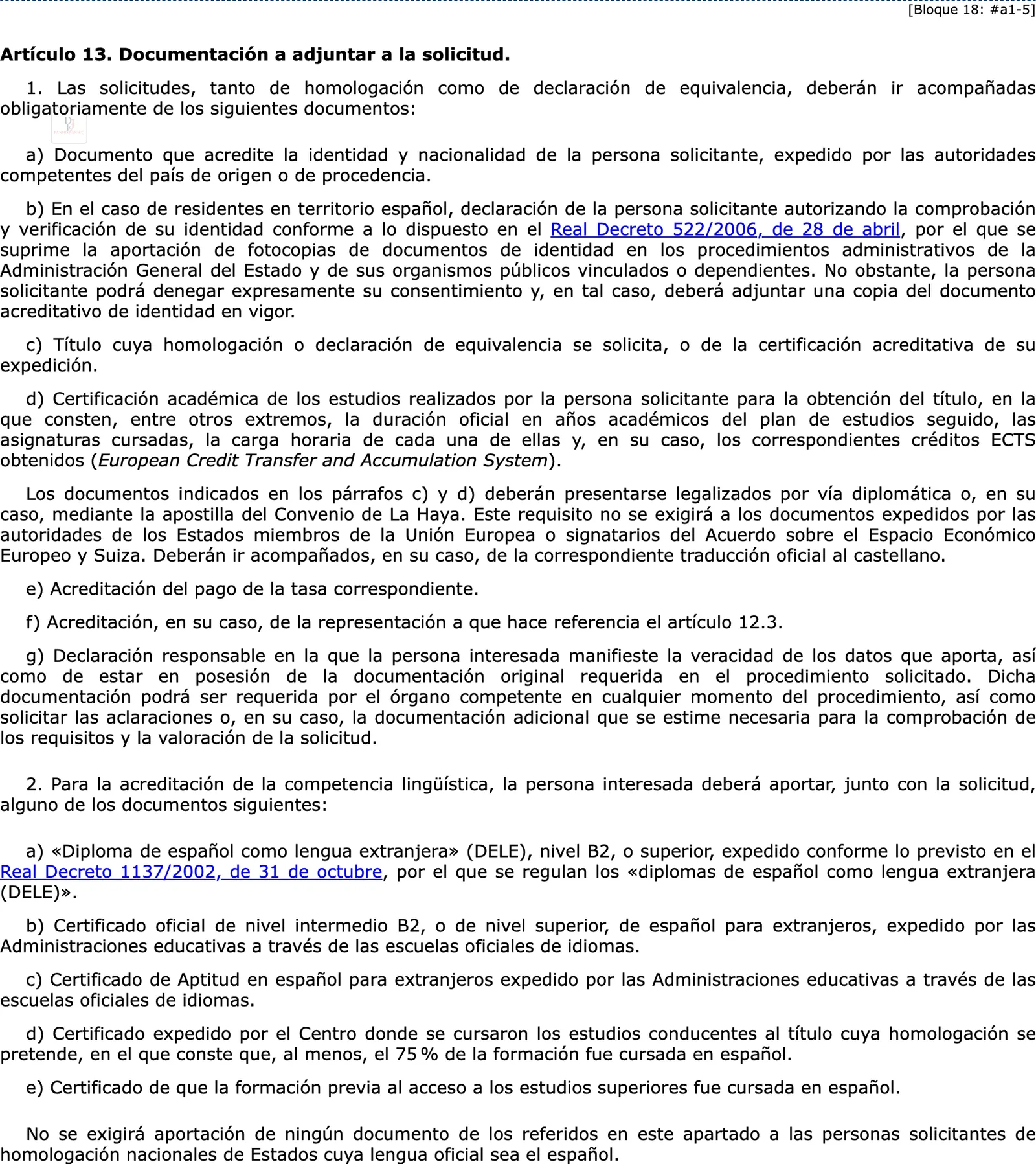
The degree and the transcript must be legalised or carry the Hague apostille. Documents issued by EU member states, EEA countries or Switzerland are exempt, and that follows the authority that issued the document, not your nationality. Anything not in Spanish needs an official translation. For how to get both, see apostille and sworn translation in Spain.
For homologation, you also prove your Spanish. A DELE diploma at B2 or higher counts, and so does a certificate from your study centre showing at least 75 % of the training was in Spanish. Nationals of states whose official language is Spanish provide none.
Cost and how to file
The fee is 166,50 euros for a homologation or equivalence application. You can pay by card or bank account while you fill in the form, which needs an NIF/CIF/NIE and a Cl@ve login. The alternatives are Modelo 790-107 or a transfer from abroad, where bank charges are yours. The fee is not refunded if the application is inadmitted, lapsed or refused.
Then:
- Get the degree and transcript apostilled or legalised, with a translation if needed.
- File in the electronic register through the online office of the Ministry of Science, Innovation and Universities (the decree calls it the Ministry of Universities). Paper is not an option, and appeals go the same way.
- Pay and attach the proof of payment.
- Check your file’s status online.
How long it takes
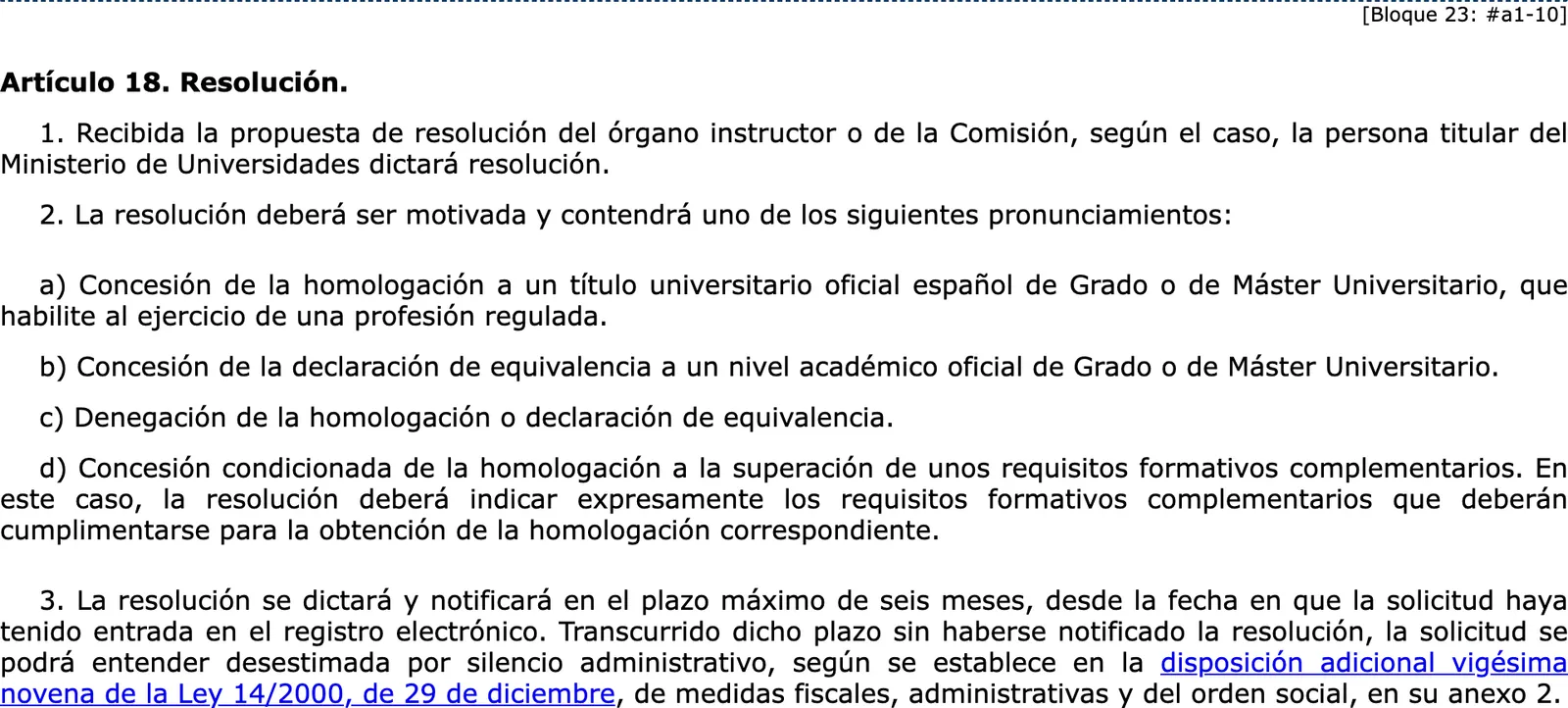
The ministry must decide within six months of your application entering the electronic register. If nothing is notified by then, it may be treated as refused by administrative silence. A grant can come with conditions, such as complementary training.
Studying instead of practising
If you only want a Spanish Master, you may not need homologation. A Grado-level degree from outside the European Higher Education Area can give access once the university checks your level, provided your country allows postgraduate study. That entry does not homologate the degree. Dates and fees are in the university guide for foreigners.
Doctorate-level equivalence follows a separate procedure in the same decree’s second additional provision. Partial foreign studies can be convalidated against a Spanish degree, which is a separate route.
Step by step
- Check your profession on the listIf it is regulated and listed, ask for homologation. If not, ask for equivalence.
- Legalise and translate your documentsThe degree and transcript need diplomatic legalisation or the Hague apostille, plus an official Spanish translation where needed.
- Prove your SpanishFor homologation, show the Spanish required for the profession, for example a DELE diploma at B2 or higher.
- File online and paySubmit through the ministry's online office and pay 166,50 euros.
- Track the fileCheck the status of your file online.
Not confirmed: A non-EU national holding an EU-issued degree: the EU decree names EU nationals, so ask the Ministry of Science, Innovation and Universities before you file.
Common questions
Do I need homologación to work in Valencia?
Only if your profession is on the ministry's regulated list. Even then, you must still meet the profession's own entry requirements.
How much does the application cost?
The fee is 166,50 euros. It is not refunded if the application is inadmitted, lapsed or refused.
How long does the ministry take to decide?
The ministry must decide within six months of the application entering the electronic register. After that it may be treated as refused by administrative silence.
Can I apply on paper?
No. Everything goes through the ministry's online office, appeals included.
Do I need Spanish to be homologated?
Yes, proof of the Spanish needed for the profession, such as a DELE diploma at B2 or higher. Nationals of states whose official language is Spanish provide none.
Can lawyers homologate a foreign law degree?
No. Lawyers and court attorneys are marked as not susceptible to homologation on the ministry's list.
Does an EU degree need homologación?
Academic equivalence still follows the main decree. EU nationals who want to practise a regulated profession with a qualification from another member state follow a separate EU decree.
Read next
Sources and reader comments
Official legal texts (BOE, DOGV, government portals):
- BOE-A-2022-17045, Real Decreto 889/2022, de 18 de octubre, homologación, declaración de equivalencia y convalidación de enseñanzas universitarias de sistemas educativos extranjeros (BOE consolidated text) (opens in a new tab)
- Ministerio de Ciencia, Innovación y Universidades: Homologación de títulos extranjeros de educación superior (opens in a new tab)
- BOE-A-2017-6586, Real Decreto 581/2017, de 9 de junio, reconocimiento de cualificaciones profesionales de la Unión Europea (BOE consolidated text) (opens in a new tab)
- Ministerio de Ciencia, Innovación y Universidades: Tasa de homologación y equivalencia (modelo 790-107) (opens in a new tab)
- BOE-A-2021-15781, Real Decreto 822/2021, de 28 de septiembre, organización de las enseñanzas universitarias (BOE consolidated text) (opens in a new tab)
General information checked against the sources listed above. Prices, opening hours and other details change; confirm them with the provider before you act. See how guides are checked.
Spotted an error? Report it.
Comments (0)
Be the first to ask about this topic.