Dentist in Valencia: Public Cover vs Private Care (2026)
Public dental care covers acute problems, extractions and screening for the whole population. Children get more: the national list runs up to age 14 inclusive, and the Valencian programme offers fillings and root-canal treatment to under-15s. Orthodontics, aesthetic treatment, implants and dentures are excluded.
On this page
Got a toothache? Go to your health centre: public care covers acute dental problems and extractions. Routine fillings are not on the list for adults in general, so most adults pay privately for them; adults with a qualifying disability of 33% or more get the conservative dentistry in the children’s portfolio.
What does public care cover for adults?
Think emergencies, not maintenance. The public list includes treatment of acute problems such as infections, inflammation, injuries and acute jaw-joint pain. It also covers drug treatment, extractions and minor mouth surgery, plus screening for pre-malignant lesions.
It names no routine fillings or check-ups for adults in general. Two groups get more: people over 14 with a disability of 33% or more that prevents proper oral self-care, and people diagnosed with head-and-neck cancer, who get an oral examination and preventive treatment. The Valencian health law only tells the Conselleria to study a wider list, so plan around what exists today. Before you book private treatment, ask your health centre what applies to you. The SIP card guide and the GP registration guide explain how to get in.
What do children get?
Quite a lot more. The national list covers children from birth up to age 14 inclusive, with check-ups and fillings in permanent teeth when indicated. In the Comunitat Valenciana, every child under 15 is offered a yearly check, fillings and root-canal treatment in permanent teeth.
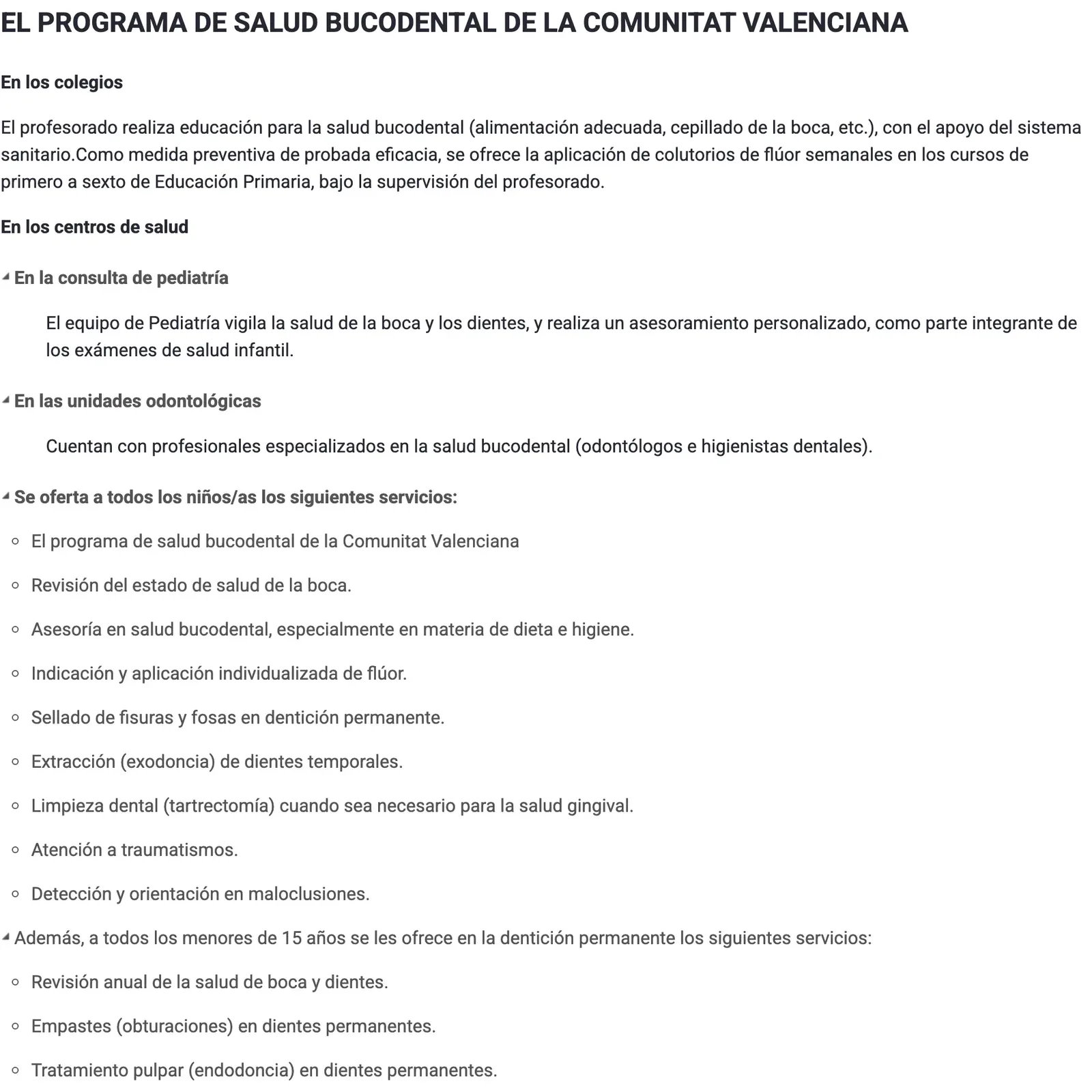
The two lists differ on root-canal work, so ask the dental unit what your child gets. Pregnant women also get at least one dental visit, ideally in the first trimester.
Which treatments are not publicly covered?
Plan to pay for orthodontics, treatments with an exclusively aesthetic purpose, and implants and dentures, except those in the orthoprosthetic portfolio. Definitive fillings and pulp treatments in baby teeth are private too.
Dental add-ons on private insurance differ from policy to policy. The private insurance guide and the public vs private comparison show how it fits.
How do you choose a private dentist?
Check the dentist’s name on the college of dentists’ register before your first visit. A status of A means active, and I means barred. The college is at Calle Luis Merelo y Mas, 1 Bajo, 46023 Valencia, and you can call it on 96/374 49 61.
Then ask for the price in writing. Spanish law requires the clinic to give you the total price with all taxes before you are bound by a contract, and to say how the price is set when it depends on a budget. Treatment plans often change once the dentist sees what is under an old filling, so I recommend asking whether the figure includes the first visit and X-rays. If your Spanish is still basic, ask at the same time whether the dentist treats in English.
What if something goes wrong?
Talk to the clinic first. If that fails, the college of dentists of Valencia processes complaints about dentists registered in the province. You fill in its form and attach a copy of the patient’s DNI. If you have no DNI, call the college first to ask which ID it accepts. Sign every page of the form, or it will not be processed.
Do not wait on the college: it sets no maximum time to answer, and you can start other claims in court or out of court in parallel.
Step by step
- Go to your health centre for an acute problemTreatment of acute dental processes is part of the primary-care list for the whole population.
- Ask what the public list coversExtractions and surgical extractions are on it; orthodontics, aesthetic treatment, implants and dentures are not.
- Check any private dentist's registrationSearch the college's register; status A means active.
Not confirmed: Whether the Comunitat Valenciana adds adult dental services: its programme covers children and its health law only commits to study a wider list; ask your health centre first. Which dentist is on duty at weekends: ask the college. What a private dental add-on covers: read the policy.
Common questions
Does the public system cover a toothache?
Acute problems are on the public list for the whole population: infections, inflammation, bone-and-tooth injuries, wounds of the oral mucosa and acute jaw-joint pain. Drug treatment and extractions are included too.
Are fillings free for adults?
The list for the whole population names no fillings. Fillings appear in the children's list for permanent teeth, and people over 14 with a disability of 33% or more that prevents oral self-care get that conservative dentistry too. Ask your health centre what applies to you before booking private treatment.
What does the public system cover for my child?
The national list covers children from birth up to 14 years inclusive, with check-ups and fillings in permanent teeth. The Valencian programme offers under-15s a yearly check, fillings and root-canal treatment on permanent teeth.
Is orthodontics covered by the public system?
No. Orthodontic treatments are excluded from the public dental portfolio. Treatments with an exclusively aesthetic purpose are excluded too.
Are dental implants covered?
No. Dental implants and dental prostheses are excluded, except those in the orthoprosthetic portfolio.
How do I check that a dentist is registered?
Use the college of dentists' register search, the buscador de colegiados. A status of A means active; I means inhabilitado.
Should I get a price in writing before treatment?
Spanish consumer law requires the business to give you the total price with all taxes before you are bound by a contract. Where the price depends on a budget (presupuesto), it must say how the price is determined. Ask the clinic to put the budget in writing.
Who do I complain to about a dentist?
The college of dentists of Valencia processes complaints about dentists registered in the province. It sets no maximum time to answer, and you can start other claims in parallel, in court or out of court.
Does the public system cover adult check-ups and fillings in Valencia?
Not on the lists read here. The Valencian health law only tells the Conselleria to study a wider public dental list and the possibility of extending access to the rest of the population.
How do I find an English-speaking dentist?
Ask the clinic before you book whether the dentist treats in English, then check the name on the college register.
Does pregnancy change what is covered?
Yes. Pregnant women have at least one dental visit, preferably in the first trimester. Health staff can refer you, or you can ask for it.
Read next
Sources and reader comments
Official legal texts (BOE, DOGV, government portals):
- BOE consolidated text: Real Decreto 1030/2006, de 15 de septiembre, cartera de servicios comunes del Sistema Nacional de Salud, Anexo II apartado 9 (last update published 31/07/2026) (opens in a new tab)
- Conselleria de Sanidad (san.gva.es), El programa de salud bucodental de la Comunitat Valenciana (page undated; checked 21 Oct 2026) (opens in a new tab)
- BOE consolidated text: Ley 10/2014, de 29 de diciembre, de Salud de la Comunitat Valenciana, art. 57 bis (opens in a new tab)
- BOE consolidated text: Real Decreto Legislativo 1/2007, de 16 de noviembre, Ley General para la Defensa de los Consumidores y Usuarios, art. 60 (last update published 28/02/2026) (opens in a new tab)
Company and press pages (not official sources):
General information checked against the sources listed above. Prices, opening hours and other details change; confirm them with the provider before you act. See how guides are checked.
Spotted an error? Report it.
Comments (0)
Be the first to ask about this topic.