Valencia Weather by Month: Climate, Heat and Rain
Valencia has mild winters, a hot and humid summer and a wet autumn. January is the coolest month at 11.8 °C on average, and August is the hottest. October brings the most rain, while July is the driest month of the year.
On this page
Move in winter if you hate heat, and expect to run the air conditioning from June to September: Valencia’s winters are mild, and August is the hot, humid month.
What is the weather like month by month?
This table gives the mean temperature, the daily high and the rain for the months that matter most.
| Month | Mean °C | Daily high °C | Rain mm |
|---|---|---|---|
| January | 11.8 | 16.4 | 37 |
| April | 16.2 | 20.8 | 38 |
| July | 25.6 | 29.7 | 8 |
| August | 26.1 | 30.2 | 20 |
| October | 19.7 | 24.3 | 77 |
Winter is easy: January is the coolest month, but nights still average 7.1 °C and frost is rare, at about 0.5 days a year. Ask how a flat is heated before you sign, though, because many older buildings have no central heating.
How hot and humid is summer?
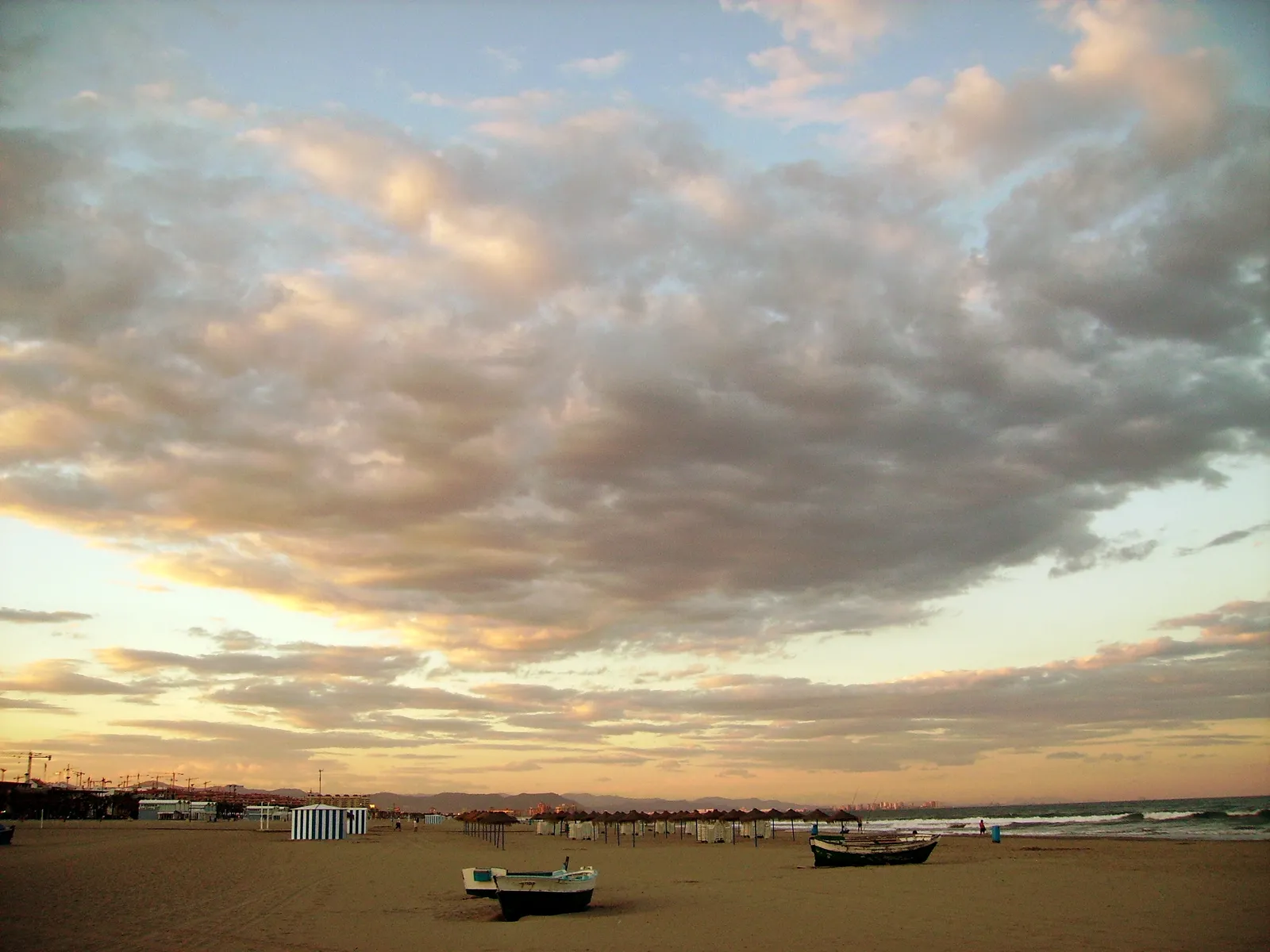
Plan for heat from June, when the mean already reaches 22.9 °C. August is the peak, with a daily high of 30.2 °C and humidity of 68 %, so the air feels stickier than the number suggests. July is the sunniest month, at 314 hours of sun.
When you view a flat in summer, check the bedroom first: August nights only cool to 21.9 °C on average. A bedroom with air conditioning and shutters is worth paying more for.
When do heat warnings start?
AEMET issues warnings by forecast zone, not by street. On the coast, in the Litoral sur de Valencia zone, a 36 °C maximum means yellow, 39 °C orange and 42 °C red. The Interior sur de Valencia zone sets higher thresholds, at 38, 40 and 44 °C. Open AEMET’s warning map to see which zone covers your address.
Yellow means no risk for most people but some risk for certain activities. Orange is an important risk, and red an extreme one.
When does it rain?
October is the wettest month at 77 mm, and September follows with 70 mm. July is the driest, at 8 mm. Expect short heavy storms in autumn rather than steady drizzle, so read the flood guide before you sign a lease.
For today’s forecast, open the Valencia weather page. To weigh one area against another, start with the neighbourhood guide.
How do you stay safe in a heat wave?
Heat can cause dehydration, heat stress and heat stroke. If your flat is too hot in the afternoon, go to one of the city’s 39 climate shelters, which have shade, air conditioning and drinking water. The 2026 expansion guarantees at least one in every district. For water on the move, 77 free fountains offer filtered, chilled drinking water.
The health ministry’s core rules are simple:
- Drink water often, even when you are not thirsty.
- Cut back on exercise and outdoor sport in the central hours of the day.
- Never leave anyone in a parked, closed car.
Running costs in a hot summer are covered in our guide to utilities and internet contracts. To set this city against Spain’s other big one, read Valencia vs Barcelona.
Photos (2)
- Manuel Martin Vicente, Wikimedia Commons (CC BY 2.0 (opens in a new tab))
- Frnevado, Wikimedia Commons (CC BY-SA 4.0 (opens in a new tab))
Not confirmed: These are long-term averages, not a forecast for any one summer. AEMET's warning map shows which heat-warning zone covers your address.
Common questions
Which is the hottest month in Valencia?
August, with a mean of 26.1 °C and a daily maximum of 30.2 °C. July is close behind at 25.6 °C.
When does it rain most in Valencia?
October and September, with 77 mm and 70 mm on average, against 8 mm in July.
How humid is Valencia?
Humidity averages 65 % over the year and peaks at 68 % in August.
Does it freeze or snow in Valencia?
Rarely: about 0.5 frost days and 0.1 snow days a year. Even January nights average 7.1 °C.
At what temperature does a heat warning start in Valencia?
On the coast, a 36 °C maximum triggers yellow, 39 °C orange and 42 °C red. Inland to the south, the thresholds are 38, 40 and 44 °C.
Read next
Sources and reader comments
Official sources:
- AEMET, Valores climatológicos normales: València (8416), periodo 1981-2010 (opens in a new tab)
- AEMET, Plan Meteoalerta, Anexo 1: Umbrales y niveles de aviso (versión 1, 31-may-2022) (opens in a new tab)
- Protección Civil / AEMET, Plan Meteoalerta (documento Meteoalerta v6) (opens in a new tab)
- Generalitat Valenciana, Conselleria de Sanidad: Altas temperaturas (Salut Pública) (opens in a new tab)
- Ayuntamiento de València: Recursos y servicios de València ante la ola de calor (opens in a new tab)
General information checked against the sources listed above. Prices, opening hours and other details change; confirm them with the provider before you act. See how guides are checked.
Spotted an error? Report it.
Comments (0)
Be the first to ask about this topic.