Exchange Your Driving Licence in Valencia (2026 Guide)
Moved to Spain with a foreign licence? It stops being valid six months after you acquire normal residence. EU and EEA licences exchange with no exam. Other licences exchange without an exam where Spain has an agreement with the issuing country. The fee is €28.87 when no tests are needed. Book a cita previa at a Jefatura.
Also in: Deutsch
On this page
- How long can you drive on your foreign licence?
- Can you exchange your licence?
- What documents do you need?
- How do you book at the Valencia Jefatura?
- Is your country on the two-phase list?
- What happens after the exchange?
- What do the blue, green and orange parking zones mean?
- How do you get a resident parking badge?
- What happens if the tow truck (grúa) takes your car?
- Step by step
- Common questions
Driving in Valencia on a foreign licence? The clock is six months from when you acquire normal residence in Spain. After that you need a Spanish licence, and the exchange costs €28.87 when no tests are needed. Parking and towing rules for València city close the guide.
How long can you drive on your foreign licence?
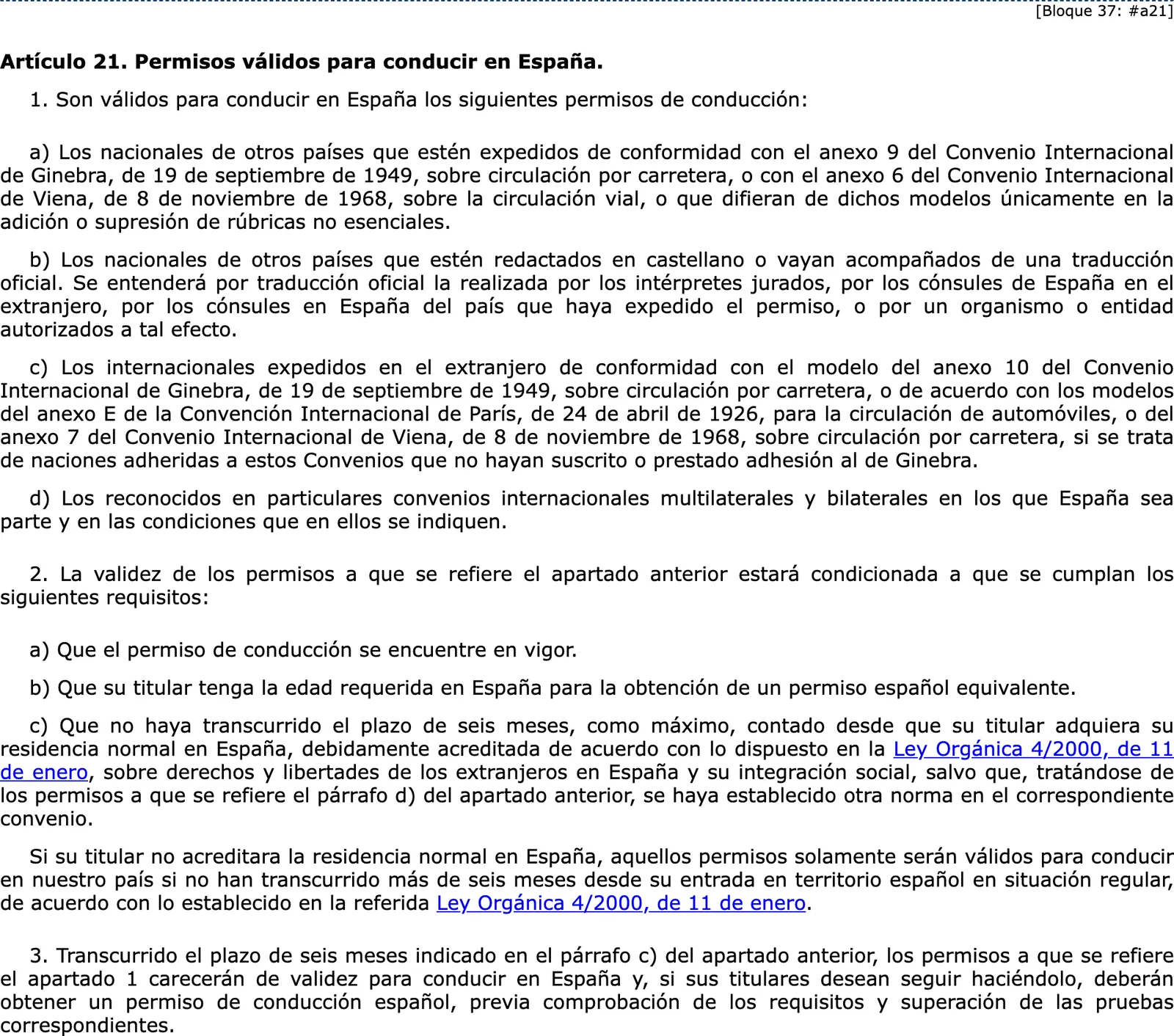
A non-EU licence is valid in Spain for at most six months, counted from when you acquire normal residence in Spain.
c) Que no haya transcurrido el plazo de seis meses, como máximo, contado desde que su titular adquiera su residencia normal en España, debidamente acreditada de acuerdo con lo dispuesto en la Ley Orgánica 4/2000, de 11 de enero, sobre derechos y libertades de los extranjeros en España y su integración social, salvo que, tratándose de los permisos a que se refiere el párrafo d) del apartado anterior, se haya establecido otra norma en el correspondiente convenio.
That the maximum period of six months has not elapsed since its holder acquired normal residence in Spain, duly proved in accordance with Organic Law 4/2000, unless another rule has been set in the corresponding agreement.
BOE · Real Decreto 818/2009, art. 21.2.c
If you cannot prove normal residence, the six months run from your regular entry into Spain. After six months the licence is no longer valid, and you need a Spanish permit to keep driving.
Normal residence means staying in Spain at least one hundred and eighty-five days per calendar year, in a regular situation. You can exchange the day you acquire it, with no wait.
A foreign licence is valid in Spain if it is in force and you have the age Spain requires for the equivalent permit. It is also valid if it is in Spanish or carries an official translation.
Can you exchange your licence?
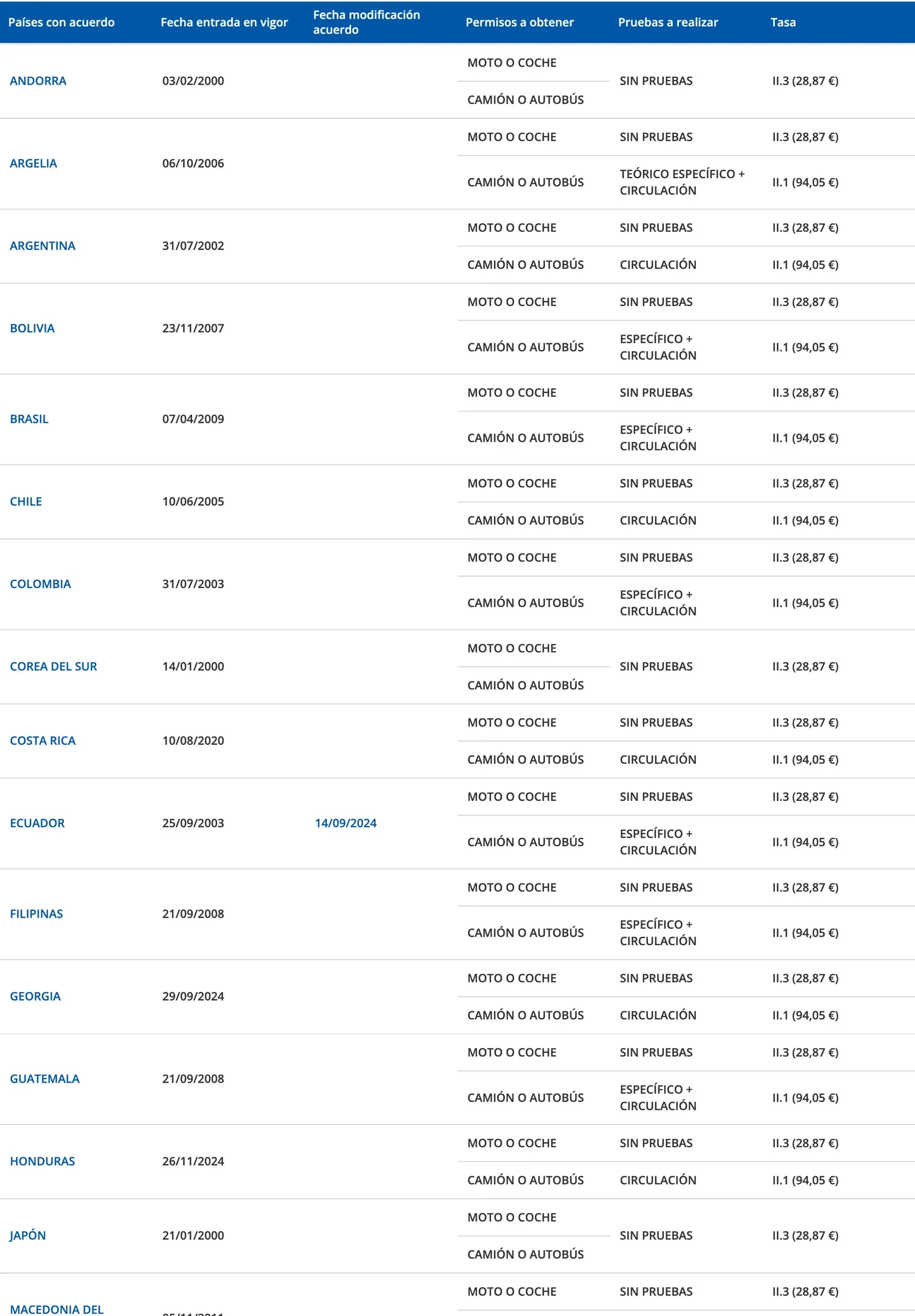
EU and EEA licences
EU and EEA licences can be exchanged for residents in Spain. The exchange needs no exam. It is voluntary while the licence is in force.
An EU or EEA licence stays valid on its original terms, but the minimum age is the Spanish one. Once you are resident, Spanish rules on validity, medical-fitness checks and points apply. A licence with no fixed validity period must be renewed after two years of residence.
Does your country have an exchange agreement?
Licences from other countries exchange through an agreement where one exists. Without one, the route below applies. The DGT table below is dated 26/06/2026. Each row below gives car and motorbike licences without tests, for fee code II.3, €28.87.
| Country | Agreement in force (dd/mm/yyyy) |
|---|---|
| Andorra | 03/02/2000 |
| Algeria | 06/10/2006 |
| Argentina | 31/07/2002 |
| Bolivia | 23/11/2007 |
| Brazil | 07/04/2009 |
| Chile | 10/06/2005 |
| Colombia | 31/07/2003 |
| South Korea | 14/01/2000 |
| Costa Rica | 10/08/2020 |
| Ecuador | 25/09/2003 |
| Philippines | 21/09/2008 |
| Georgia | 29/09/2024 |
| Guatemala | 21/09/2008 |
| Honduras | 26/11/2024 |
| Japan | 21/01/2000 |
| North Macedonia | 05/11/2011 |
| Morocco | 08/06/2004 |
| Moldova | 29/09/2024 |
| Monaco | 13/11/2013 |
| Nicaragua | 02/01/2012 |
| New Zealand | 02/06/2023 |
| Panama | 11/07/2014 |
| Paraguay | 28/10/2007 |
| Peru | 28/01/2004 |
| United Kingdom | 16/03/2023 |
| Dominican Republic | 16/01/2007 |
| El Salvador | 24/06/2009 |
| Serbia | 11/03/2009 |
| Switzerland | 02/07/1998 |
| Tunisia | 29/07/2011 |
| Turkey | 25/04/2011 |
| Ukraine | 31/10/2010 |
| Uruguay | 05/11/2003 |
Lorry and bus licences (categories C and D) need extra practical or theory tests. A licence covering only motorcycles, cars and light vehicles is generally exchanged without an exam.
A licence obtained in your home country while you were already a legal resident in Spain cannot be exchanged.
What if your country has no agreement?
The route without an agreement has two conditions. You pass a road test of at most 30 minutes. You also prove at least six months as a professional driver for a company established in Spain, with Social Security records.
What documents do you need?
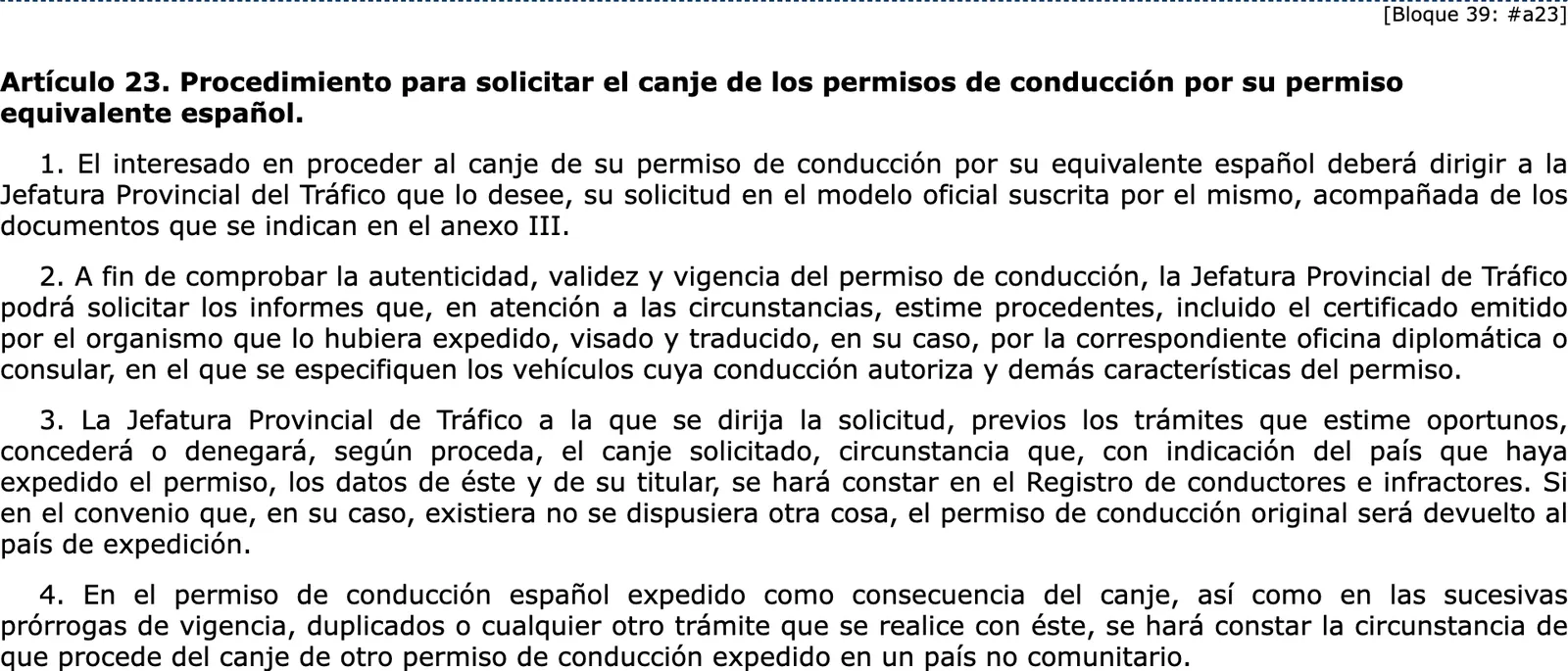
Start with the fitness report: get the psychophysical fitness report before you apply, from an authorised Centro de Reconocimiento de Conductores. For licences covering only A and B, the group I report is enough.
Bring these:
- Identification: a valid DNI or passport, or the residence authorisation for non-EU foreigners.
- Proof of residence. A non-EU citizen exchanging an EU or EEA licence shows a valid residence card. An EU citizen shows the registration certificate.
- For a non-EU licence: proof that you were not residing in Spain when it was issued.
- The original foreign licence, valid and in force.
- A current 32 x 26 mm colour photo on a plain background for an EU or EEA exchange. Since 6 November 2024 photos are not asked again where the DGT already holds them.
- Proof of payment of the fee.
The application goes to the Jefatura Provincial de Tráfico of your choice. The Jefatura may ask for a certificate from the body that issued the licence, endorsed and translated by a diplomatic or consular office if needed.
The fee is tasa 2.3, €28.87, when no extra tests are needed. Tip: pay by card at the office, never in cash, or use a fee bought beforehand.
How do you book at the Valencia Jefatura?

Apply in person at any Jefatura or Traffic Office, with a cita previa. The DGT will not attend you if you book in any other way.
Book online or call 060. A specialised agent answers Monday to Friday 9:00-18:00, except national holidays. From abroad, call +34 902 887 060.
Tip: in the booking tool, pick your Jefatura first.
For an EU or EEA licence, choose the area Canje de permisos. Then pick the procedure Inscripción, sustitución y renovación de permisos europeos. Use the generic exchange procedure if your Jefatura has no such entry. For a non-EU licence, choose the area Canjes, then the procedure normally named Canje de permisos.
Carrer de Mora de Rubiols, 2, Jesus, 46007 Valencia, Spain · Open in Google Maps (opens in a new tab)
Open in Google Maps (opens in a new tab)
At the end of the exchange the DGT withdraws your original licence and hands you a provisional permit. The definitive licence arrives by post in about a month and a half. You can drive on the provisional permit for 6 months.
The provisional permit is valid only inside Spain.
Is your country on the two-phase list?
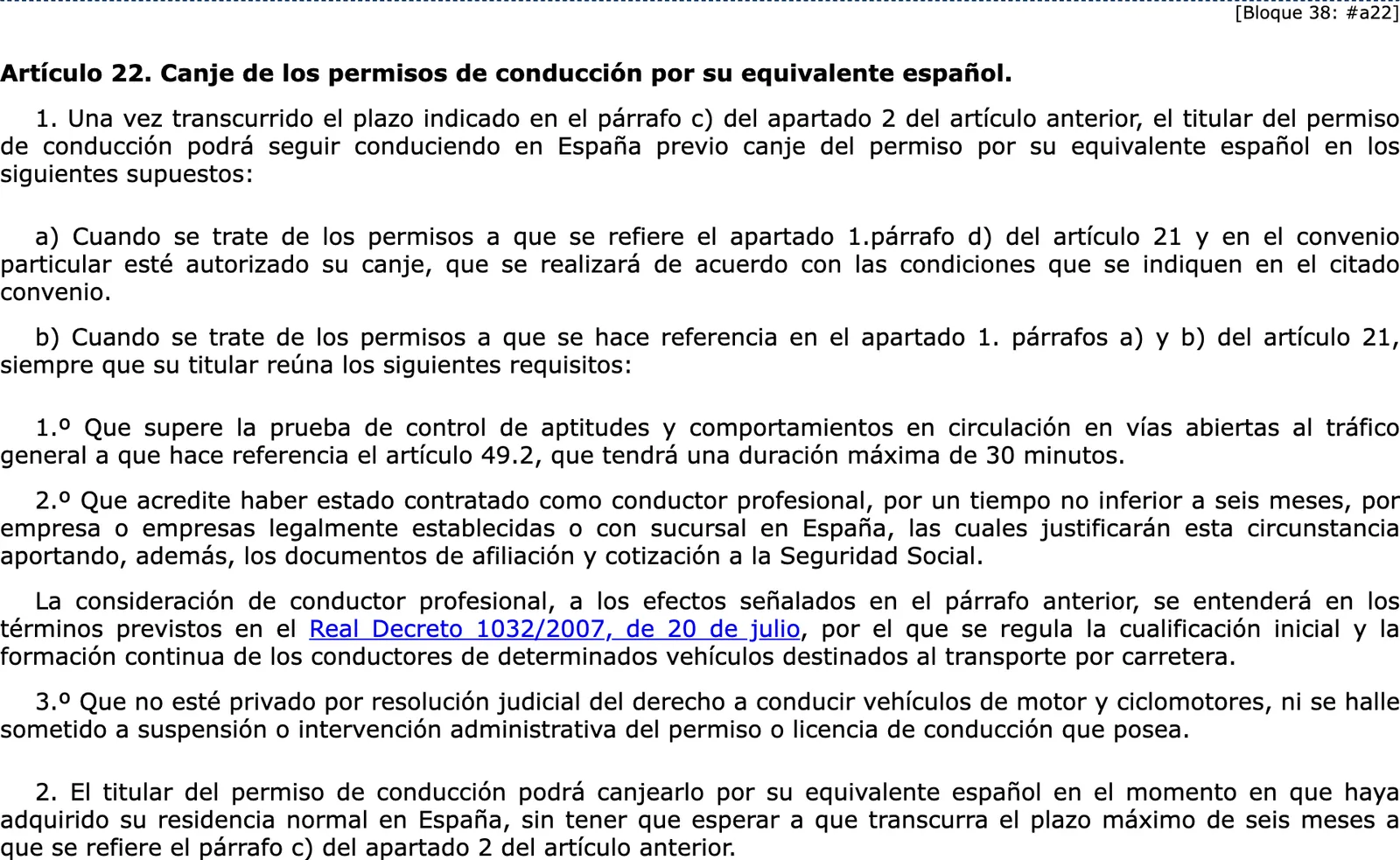
For the countries below, the DGT runs the exchange in two phases. They are Algeria, Bolivia, Brazil, Chile, Colombia, Costa Rica, Ecuador, El Salvador, the Philippines, Georgia, Guatemala, Honduras, Macedonia, Morocco, Moldova, Nicaragua, Panama, Paraguay, the Dominican Republic, Serbia, Tunisia and Turkey.
The first phase is to ask the issuing country to confirm your licence is valid. After it answers, you request the exchange. Booking the in-person appointment is what starts the verification.
Each request carries a status. PENDIENTE means your country has not answered yet. CONTESTADA means you can be seen on the day shown, which does not mean the exchange is granted.
If your country has not answered, you ask again with a new appointment. Waiting for the issuing country often lengthens the process.
Online, a non-EU licence can be exchanged with a digital certificate or Cl@ve credentials. For the finish you hand the original in at the Jefatura.
When no extra test applies, you get a receipt for the new Spanish licence that lets you drive until the definitive one arrives at your home.
What happens after the exchange?

Once you hold the Spanish licence, report a change of address to the Jefatura Provincial de Tráfico within fifteen days. Car and motorcycle permits are valid for ten years until age sixty-five, then five years.
A Spanish licence obtained by exchanging a non-EU licence carries a note saying so. Unless an agreement provides otherwise, your original foreign licence goes back to the issuing country.
International driving permits issued abroad under the Geneva, Paris or Vienna conventions are also valid in Spain.
What do the blue, green and orange parking zones mean?
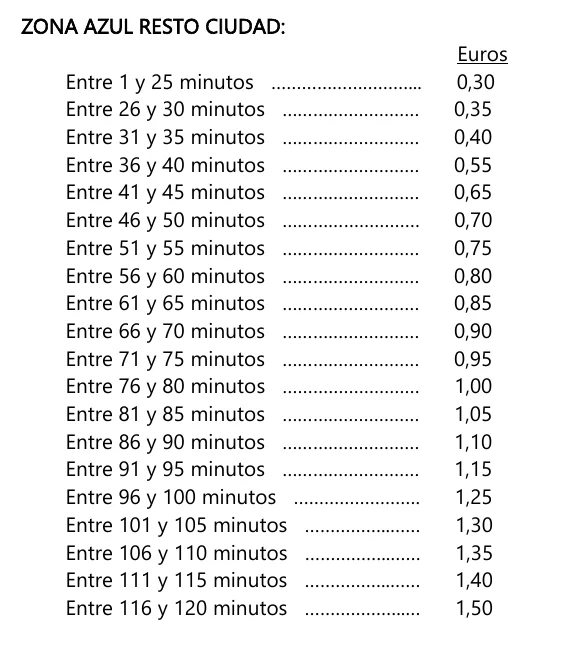
València has three kinds of regulated parking: blue, green and orange. Blue is rotation parking. Green is exclusive for residents. Orange is mixed use: rotation and residents, depending on the time of day and the day of the week.
Check the dashed line on the road: blue for general use, green for residents, orange for mixed use.
In the blue zone, or the orange zone as a non-resident, you get a ticket from the machine or pay through an app before you park. Rotation spaces run between 9 and 21 h, with a maximum stay. The Alcaldía sets the hours, the maximum stay and the days for each zone.
Tip: read the machine on your street. The conditions of each zone are posted at the machines and in the mobile apps.
After the maximum stay you cannot park again within at least 150 m of the same spot. Blue spaces are free to use outside the set hours. If you register your plate at the machine, you need not display the ticket behind the windscreen.
You pay at the machines in the barrio where you park, or through the enabled telematic means. The blue zone centre covers the districts of Ciutat Vella, L’Eixample and Extramurs.
The rates below come from the parking fee ordinance as amended from 4 March 2022, in the text archived in April 2026.
| Zone (non-residents) | 1 hour | 2 hours |
|---|---|---|
| Blue, centre and ensanches | €1.00 | €1.70 |
| Blue, rest of the city | €0.80 | €1.50 |
| Orange | €2.10 | €3.30 |
How do you get a resident parking badge?
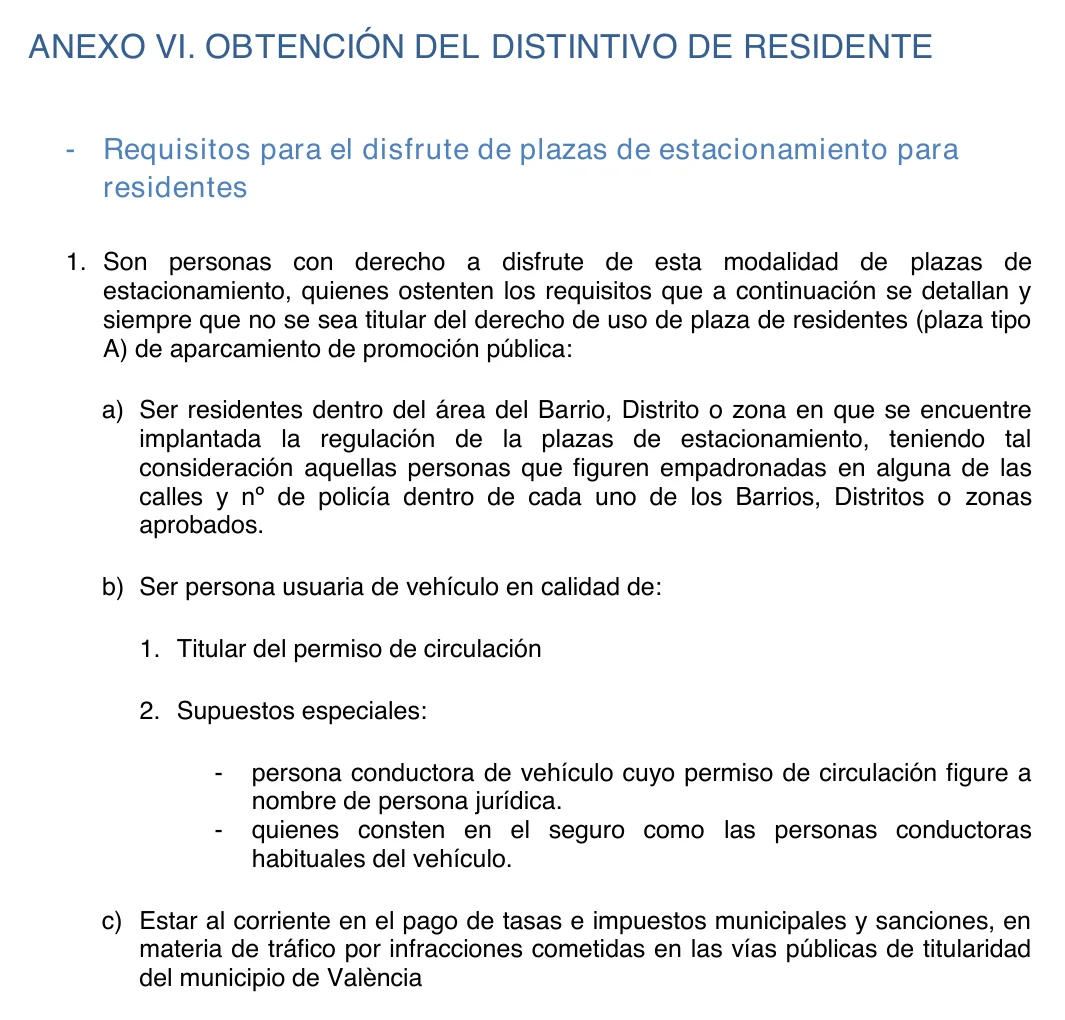
Want the green zone? You need the resident badge (distintivo de residente). It lets you use the free spaces painted green and orange in the barrio, district or zone where you are on the padrón. Outside those limits it has no validity.
Who qualifies?
- You are on the padrón at a street and number inside one of the approved barrios, districts or zones. Start with registering on the padrón.
- You use the vehicle as holder of the circulation permit.
- The special cases are a driver of a vehicle registered to a legal person, and people named on the insurance as habitual drivers.
- You are up to date with municipal taxes and with traffic fines on València’s public roads.
- You do not hold a type A resident space in a public-housing car park.
- To park on the resident rate, a car owned by an individual must have València as its fiscal domicile in the DGT register.
What do you bring?
- A valid DNI showing the address that matches the padrón, or a NIE.
- A copy of the circulation permit and the insurance, and a valid ITV.
- A certificate of being up to date with municipal taxes and traffic fines, or an authorisation for the operator to obtain it.
- For a car owned by an individual: the insurance naming you as habitual driver.
- For a company car used personally and exclusively: proof of employment (payslip, contract or deed) and an authorisation letter.
- For a rental or leasing contract: a copy of the contract.
You submit the documents at the municipal offices set up for it, or online. If the badge cannot be issued at once, it is posted to your address.
What does it cost, and how long does it last?
The resident fee is €86.20 a year, or €7.18 a month or fraction of a month, under the fee ordinance as amended from 4 March 2022. You pay at any parking machine in the city or by phone. The applicant pays before collecting the badge.
A paid period cannot be reduced, and the fee is not prorated. The badge is valid for 2 calendar years: the year you apply and the next, to 31 December. Renew in September or October of the year it ends.
Tip: the badge belongs to one plate and expires when you transfer the vehicle.
What happens if the tow truck (grúa) takes your car?
Officers may order a car removed to the pound when it is immobilised or, while parked, is a danger or seriously disrupts traffic or pedestrians. These cases count:
- double parking;
- a car in a time-limited space with no valid ticket on show, or one that has overrun three times the time paid;
- a car less than 2 m from a bus stop, unless signs say otherwise;
- a car blocking the normal use of a pedestrian crossing.
What if you cannot prove legal residence in Spain?
A car that has been immobilised can also be removed if the person fined cannot prove legal residence in Spain. The exception: the person deposits the fine and the immobilisation costs, or guarantees payment.
What does it cost?
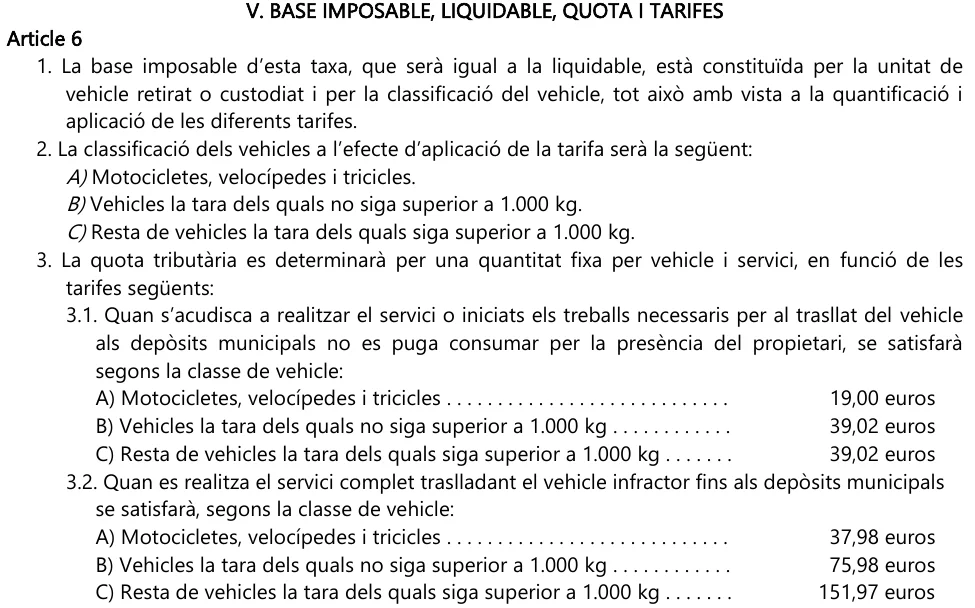
A completed tow of a car up to 1.000 kg costs €75.98, under the tow-fee ordinance applied since 1 January 2019, in the text archived in June 2025. The holder, the lessee or the habitual driver pays the removal costs, before the car is returned. The officer may withhold the circulation permit until the costs are shown to be paid.
| Vehicle | Owner arrives first | Completed tow | Custody per day |
|---|---|---|---|
| Motorcycle | €19.00 | €37.98 | €4.76 |
| Tare up to 1.000 kg | €39.02 | €75.98 | €9.50 |
| Tare above 1.000 kg | €39.02 | €151.97 | €19.00 |
Custody starts once twenty-four hours have passed since the removal. You pay before the car is handed back, at the tow unit’s premises where it is held, or to the operator. The tow fee is separate from any fine for the offence.
After more than two months in the pound the car is presumed abandoned. The holder then has fifteen days to collect it, otherwise it is treated as waste.
Temporary no-parking signs
Temporary no-parking areas for cleaning, works or events are signposted 48 hours before the area must be clear. A car moved under these signs goes to the nearest suitable place at no cost to its holder or driver. A car that arrives after the signs go up is towed to the pound at the owner’s or driver’s expense.
Tip: check the street signs when you park for the night. Temporary signs go up 48 hours ahead.
Photo credits
- Estacion del Norte, the Valencia station next to the bullring: Diego Delso, Wikimedia Commons (opens in a new tab) (CC BY-SA 4.0)
- The Ciudad de las Artes y las Ciencias complex in Valencia: Diego Delso, Wikimedia Commons (opens in a new tab) (CC BY-SA 3.0)
Step by step
- Start the six-month clock checkCount six months from the day you acquire normal residence in Spain; after that the foreign licence is no longer valid.
- Get the fitness reportGet the psychophysical fitness report from an authorised Centro de Reconocimiento de Conductores.
- Pay the feePay tasa 2.3, €28.87, by card at the office or buy it beforehand.
- Book the cita previaBook at a Jefatura, choosing the Canje de permisos area.
- Hand in the original and collect the provisional permitThe DGT withdraws your original licence and gives you a provisional permit.
Not confirmed: The current address and hours of Valencia's Jefatura: the DGT's 2019-2022 table gives Mora de Rubielos, s/n. Check your appointment confirmation. Whether your country is on the DGT agreement table beyond the rows shown here: read the DGT page before you book. Green and orange parking zones by barrio, and today's parking fees: check the street signs and machines.
Reach readers planning life in Valencia. Advertise → hello@settlevalencia.com
Common questions
How long can I drive in Spain on my foreign licence?
Six months at most: a non-EU licence is valid for six months counted from when you acquire normal residence in Spain, unless a bilateral agreement sets another rule. If you cannot prove normal residence, the six months run from regular entry into Spain.
What counts as normal residence?
Normal residence is the place where a person habitually stays, at least one hundred and eighty-five days in each calendar year. For foreigners it means staying in Spain in a regular situation, duly proved under Organic Law 4/2000.
Do I need an exam to exchange an EU licence?
No. An EU or EEA exchange requires no exam and is voluntary while your licence is in force. The fee is always tasa II.3, €28.87. You apply in person with a cita previa.
Can I exchange a licence I got after I moved to Spain?
No. A licence obtained in your home country while you were already a legal resident in Spain cannot be exchanged. The exchange also asks you to prove you were not residing in Spain when the foreign licence was issued.
How much does the exchange cost?
When no extra tests are needed, which is the case for licences covering only A and B, the fee is tasa 2.3 at €28.87. You pay by card at the office, never in cash, or use a fee bought beforehand.
How long until the Spanish licence arrives?
About a month and a half by post. At the end of the exchange the DGT withdraws your original licence and hands you a provisional permit. You can drive with the provisional permit for 6 months.
Can I drive abroad with the provisional permit?
No. The provisional permit is valid only inside Spain. For driving abroad you need the International Driving Permit. Request it at any Jefatura or Traffic Office with a cita previa.
What if my country has no agreement with Spain?
The exchange without an agreement needs a road test of at most 30 minutes. You also prove at least six months as a professional driver for a company established in Spain, with Social Security records.
How much does resident parking cost in Valencia?
€86.20 a year, or €7.18 a month or fraction of a month, for the orange or green zone. Those rates come from the fee ordinance as amended from 4 March 2022. You pay at any parking machine in the city or by phone, and a paid period cannot be reduced or prorated.
What does it cost to get my car back from the grúa?
Under the tow-fee ordinance applied since 1 January 2019, a completed tow costs €75.98 for a car with a tare up to 1.000 kg and €151.97 above that. Custody adds €9.50 or €19.00 per day or part of a day once twenty-four hours have passed. Any fine is separate.
Read next
General information checked against the sources listed above, not legal advice for your situation. Rules and office practice change; confirm with the immigration office or a licensed adviser before you act. See how guides are checked.
Spotted an error? Report it.