Moving to Spain with a Dog or Cat: Valencia Rules (2026)
A dog, cat or ferret needs a microchip and a rabies vaccine; a first dose is valid only after 21 days. From the EU it travels with a pet passport. From the US or UK it needs an animal health certificate issued or endorsed within ten days before entry. In València city, dogs join the municipal census.
Also in: Deutsch
On this page
- Can you bring your dog or cat to Spain?
- What does your pet need from another EU country?
- What does your pet need from the US, the UK or another non-EU country?
- Where do you land, and who checks the animal?
- How do you register the microchip in Valencia?
- How do you put your dog on the Valencia census?
- Do the dog course and dog insurance apply to you?
- What are the leash, excrement and beach rules?
- Step by step
- Common questions
Flying to Valencia with a dog or cat? Since 22 April 2026, non-commercial pet travel runs on a new EU rulebook, Delegated Regulation (EU) 2026/131. From an EU country the paper is a pet passport; from outside the EU, an animal health certificate. Once you land, the Comunitat Valenciana adds its own registry, and the city of València its dog census.
Can you bring your dog or cat to Spain?
Yes, as a non-commercial pet movement: five or fewer animals, no commercial purpose and no transfer of ownership. More than five is possible only for documented competitions, exhibitions or sporting events, with animals over 6 months.

All the animals travel in a single means of transport, unless that transport is public. They do not have to share your flight: a separate trip is allowed within five days of your own. Someone else carrying the animal for you? A written authorisation signed by you goes with the identification document.
Puppies and kittens face a firm floor. Spain grants no exceptions and does not authorise the entry of dogs, cats and ferrets under 15 weeks old.
What does your pet need from another EU country?
A microchip, a valid rabies vaccine and an EU pet passport. The details:
- Microchip, or a legible tattoo applied before 3 July 2011.
- Rabies vaccine: the minimum age to vaccinate is 12 weeks. A complete first vaccination must be given at least 21 days before the trip; a revaccination under the validity rules counts as well.
- EU pet passport, issued in the Member State where you habitually live. Its owner, description, marking, passport-issue and rabies sections must be filled in.

Norway and Northern Ireland count as equivalent to the EU in health terms. So do the Annex I countries of Implementing Regulation (EU) 2026/636: Andorra, Switzerland, the Faroe Islands, Gibraltar, Greenland, Iceland, Liechtenstein, Monaco, San Marino and the Vatican City State.
Tip: if the chip does not meet the EU technical standard, pack a reader that can scan it; you must provide one on request.
What does your pet need from the US, the UK or another non-EU country?
From outside the EU, the animal travels with an animal health certificate in the EU model. A vet in the country of departure fills it in, and the dates are strict.

What goes into the certificate file?
- An official vet of the third country signs the certificate, and it is presented at least in Spanish.
- It is issued by an official vet, or by an authorised vet and then endorsed by the country’s competent authority.
- It is issued or endorsed no more than ten days before the date of entry into the EU.
- Certified copies of the vaccination details are attached, plus the antibody-test report where the animal needed a test. A certified copy is a photocopy stamped by the authority that issues the export certificate.
- A signed declaration confirms the movement is non-commercial.
The certificate is valid for six months from the entry checks, or until the rabies vaccination expires if that date is earlier.
Does the animal need a rabies antibody test?
Start with the baseline. The animal must show no obvious signs of disease. It needs a complete first rabies vaccination at least 21 days before the movement, or a revaccination, and a valid antibody test.
The test is dropped when you habitually live in a listed country and the animal travels directly from there. The United States of America is on Annex II of Implementing Regulation (EU) 2026/636. So is the United Kingdom, except Northern Ireland, which counts as EU-equivalent anyway.
From a country on neither list, the animal needs the test at an authorised laboratory. The blood sample is taken at least 30 days after the rabies vaccine, and the result must reach 0.5 IU/ml.
Then comes the wait: entry is authorised only 90 days after the date the blood sample was taken. That puts the minimum age at 7 months for an animal from a country with rabies risk.
Tip: count the 90 days from the blood sample, not from the vaccine.
Where do you land, and who checks the animal?
Arriving from a third country, the animal enters only through a travellers’ point of entry designated by the Member State. In Valencia province that point is Manises airport.

At the control point, declare the animal to the Guardia Civil fiscal service or authorised customs staff and show its documents. They check the documents and the identity, and they read the chip.
The Manises checks run on demand from 9 to 14:30, and until 19 h with prior notice. Landing in the afternoon? Email the animal-health service at sanimal.valencia@correo.gob.es ahead of the flight.
Arriving without the right papers is costly. Non-compliance could mean immobilisation in quarantine facilities, return to the country of origin or, as a last resort, euthanasia, with the owner bearing the costs.
How do you register the microchip in Valencia?
Your pet’s chip needs a record in the regional registry. Under Ley 2/2023 de la Generalitat, the Valencian companion-animal law, an animal identified but not entered in an officially recognised database is not considered identified.
A vet does the registering. The vet requests it online, and the registry validates it within a maximum of three working days.
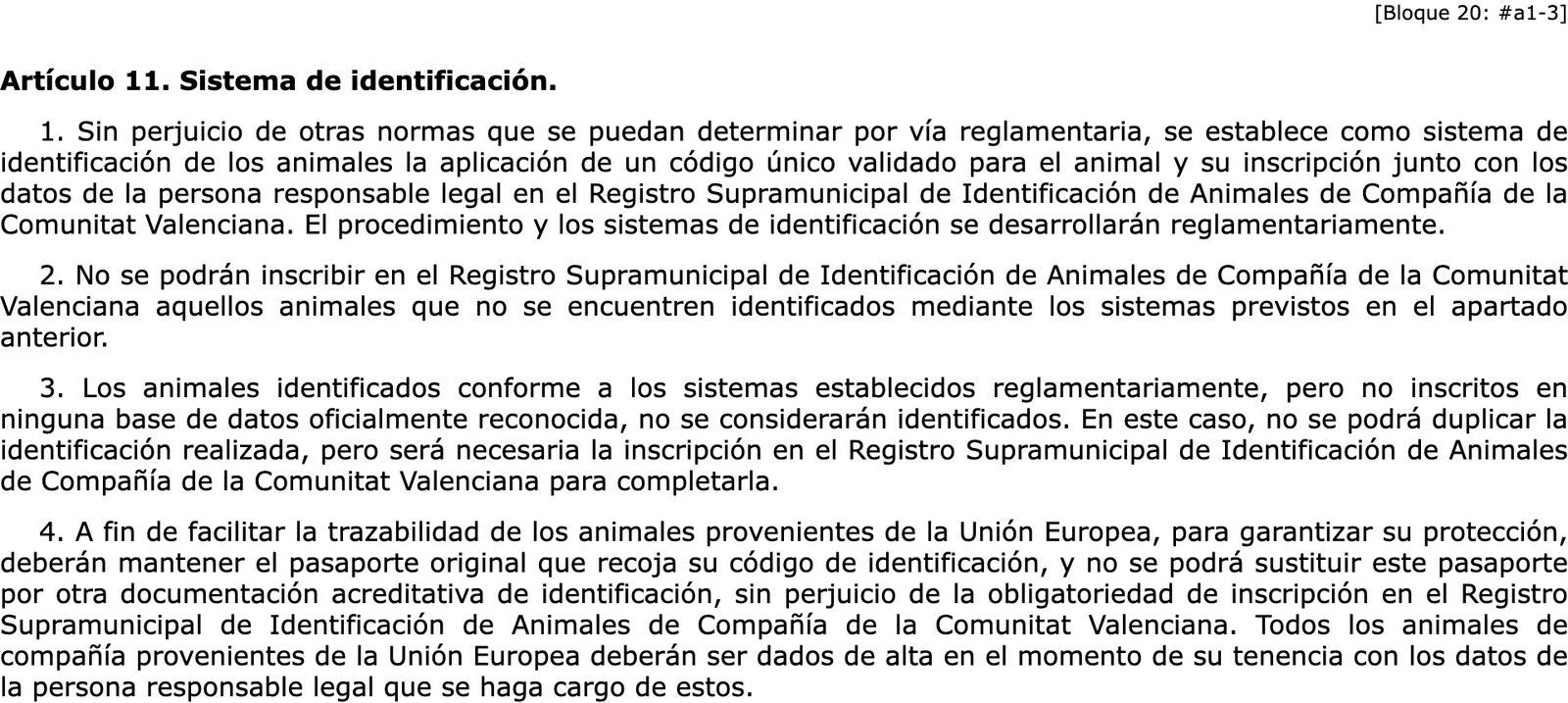
Moving from another EU country? Every companion animal coming from the EU must be registered when you take it in, with your data as legal keeper. It keeps its original passport, which cannot be replaced by other identification documents.
The same law defines identification as a validated unique code for the animal, entered with the keeper’s data in the regional registry. Its full name is Registro Supramunicipal de Identificación de Animales de Compañía de la Comunitat Valenciana. That registry took over the database of the older regional registry. For the city’s dog census, the record you need is the RIVIA registration (Registro Informático Valenciano de Identificación Animal).

What if your pet is lost, dies or moves on?
Two separate reporting duties apply to an identified animal under Ley 2/2023:
- Loss, theft or death: tell the Valencian registry within seventy-two hours and the town hall where you are registered on the padrón within forty-eight hours.
- Death or a move to another region or country: tell the authorised vet within three working days.
How do you put your dog on the Valencia census?
This step is the Ajuntament de València’s, so it applies inside the city. Adult residents of València who own dogs file the application. A minor’s dog goes in the name of an adult who lives at the address.
The deadline is 15 days after acquiring the dog, or when it turns 3 months. Before that, take dogs over 3 months to an authorised vet for the RIVIA registration.

- Bring proof of the RIVIA registration and the animal’s health booklet or passport.
- File online on the sede after pressing Iniciar trámite. Online, you pay the fee in the same procedure by bank card or Bizum.
- The fee is the tasa por prestación de servicios de sanidad, self-assessed with the A201 model.
- Wait for the identification tag by post and put it on the dog’s neck.
The animal health section of the Servicio de Sanidad is at Amadeo de Saboya, 11, Patio A, ground floor. A potentially dangerous dog needs a separate licence. Skipping the census is a minor infraction that may be fined.
Do the dog course and dog insurance apply to you?
Yes, both are national duties for anyone who holds or takes on a dog, set by Ley 7/2023, the animal welfare law. The law entered into force six months after its BOE publication. The same article leaves the course content and the insurance amount to a regulation.
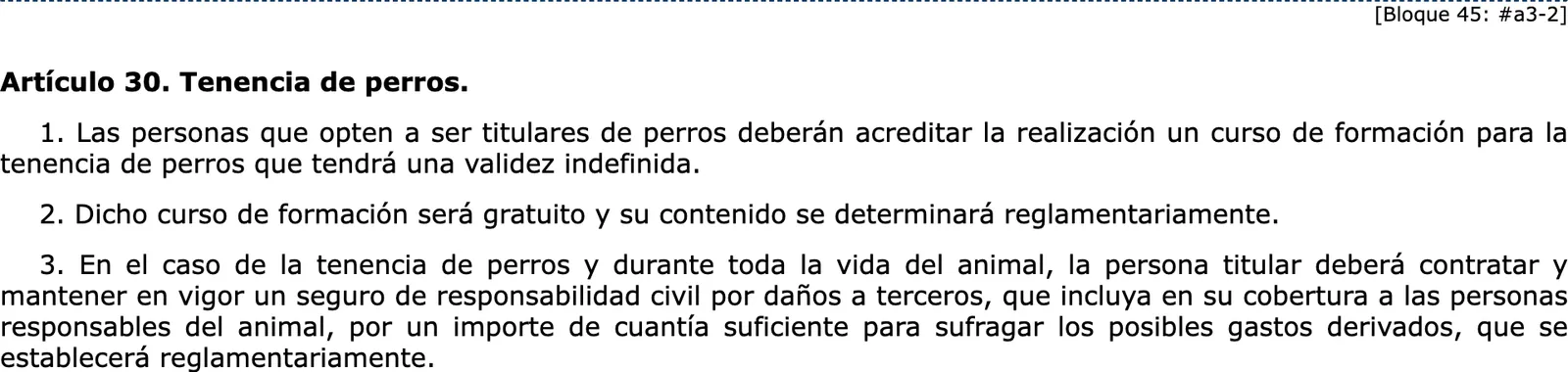
Las personas que opten a ser titulares de perros deberán acreditar la realización un curso de formación para la tenencia de perros que tendrá una validez indefinida.
Persons who wish to be holders of dogs must prove they have completed a training course for dog keeping, which will be valid indefinitely.
BOE · Ley 7/2023, art. 30.1
durante toda la vida del animal, la persona titular deberá contratar y mantener en vigor un seguro de responsabilidad civil por daños a terceros, que incluya en su cobertura a las personas responsables del animal, por un importe de cuantía suficiente para sufragar los posibles gastos derivados, que se establecerá reglamentariamente
during the whole life of the animal, the holder must take out and maintain in force third-party liability insurance, covering the persons responsible for the animal, for a sufficient amount to meet the possible resulting costs, to be set by regulation.
BOE · Ley 7/2023, art. 30.3
The course will be free, and once done it stays valid indefinitely. Until the regulation arrives, the law fixes neither the syllabus nor a minimum cover.
What are the leash, excrement and beach rules?
Across the Comunitat Valenciana, Ley 2/2023 sets the street rules. Walk a dog on public roads on a lead or similar of less than two metres at all times. Stop animals leaving excrement on pavements and public spaces, and clean up immediately if they do.

Beaches are the surprise for newcomers. On the city of València’s beaches, the municipal beach ordinance prohibits walking and staying with any type of animal at any time of year. Rescue or aid dogs, guide dogs and assistance dogs are expressly authorised when accompanied by the person who needs them.
The Ajuntament may designate a delimited beach zone where dogs are allowed, with schedules and rules of conduct. Ask the Ajuntament which zone, if any, is open. Where animals are allowed, the person leading the animal picks up and removes the excrement.
On the beach, you answer for what your animal does and for the harm it causes to people, things and the environment. Penalties follow the municipal ordinance on keeping animals and other sector rules.
Photo credits
- The Turia gardens, the long park along the old river bed in Valencia: Dorieo, Wikimedia Commons (opens in a new tab) (CC BY-SA 4.0)
- The Estacio del Nord, the railway station in the centre of Valencia: Diego Delso, Wikimedia Commons (opens in a new tab) (CC BY-SA 4.0)
- Inside the terminal building at Valencia airport: Joanbanjo, Wikimedia Commons (opens in a new tab) (CC BY-SA 3.0)
- The terminal building at Valencia airport, in Manises: Byxe, Wikimedia Commons (opens in a new tab) (CC BY-SA 4.0)
- The Generalitat palace in Valencia, seat of the regional government: Anual, Wikimedia Commons (opens in a new tab) (CC BY 3.0)
- Plaza del Ayuntamiento, the main square in central Valencia: Zarateman, Wikimedia Commons (opens in a new tab) (CC0)
- A dog exercise area in a park in Gandia, in the Valencian Community: Wikimedia Commons, Zona per a gossos del parc del País Valencià, Gandia (opens in a new tab) (CC BY-SA 4.0)
Step by step
- Chip and vaccinateMicrochip and rabies vaccine; a first vaccination is valid only after 21 days.
- Get the right paperEU pet passport from an EU country; animal health certificate from outside the EU.
- Check the antibody testNeeded unless you live in a listed country and the animal travels directly from it.
- Land at a point of entryDeclare the animal at a designated travellers' point of entry; Valencia has one at Manises airport.
- Register the chipA vet requests the registration in the Valencian registry.
- Add your dog to the censusWithin 15 days of acquiring the dog, or when it turns 3 months.
Not confirmed: Dog course and insurance: no regulation fixing course content or insurance amount turned up in the BOE on 15 October 2026; check the BOE. Census deadline for a dog you arrive with: the 15 days run from acquiring the dog; ask the Servicio de Sanidad how they count for an imported dog.
Reach readers planning life in Valencia. Advertise → hello@settlevalencia.com
Common questions
How many pets can I bring?
Five or fewer, with no commercial purpose and no transfer of ownership. Documented competitions, exhibitions or sporting events allow more, for animals over 6 months. The pets may fly separately from you, within five days of your own trip. Someone else carrying them needs your signed written authorisation.
Can a puppy fly to Spain?
Not under 15 weeks old: Spain grants no exceptions and does not authorise the entry of younger dogs, cats and ferrets. The minimum age to vaccinate is 12 weeks, and a first vaccine is valid once 21 days have passed. From a country with rabies risk, the minimum age is 7 months.
Does my dog from the US need a rabies antibody test?
No, if you live in the US and the dog travels directly from there. The United States of America is on Annex II of Implementing Regulation (EU) 2026/636. The dog still needs the animal health certificate, issued or endorsed no more than ten days before entry.
Where do I land with a pet in Valencia?
From a third country, the animal enters through a travellers' point of entry designated by the Member State. Valencia has one at Manises airport. There you declare the animal to the Guardia Civil fiscal service or customs staff and show its documents.
What if my pet does not meet the rules?
Non-compliance could mean immobilisation in quarantine facilities, return to the country of origin or, as a last resort, euthanasia, with the owner bearing the costs. The health certificate itself is valid for six months from the entry checks, or until the rabies vaccination expires if that date is earlier.
Do I have to register my dog in Valencia?
Yes, if you are an adult resident of the city of València. The dog goes on the municipal census within 15 days of acquiring it, or when it turns 3 months. Before that, an authorised vet registers dogs over 3 months in RIVIA. Not registering is a minor infraction that may be fined.
Do I need dog insurance in Valencia?
Yes, on paper: Ley 7/2023, the national animal welfare law, requires dog holders to keep third-party liability insurance for the animal's whole life. The amount is left to a regulation. The same article makes a dog-keeping course compulsory and free, with its content also set by regulation.
Can my dog go on the beach in Valencia?
No, not on the city's beaches: the municipal beach ordinance prohibits walking and staying with any type of animal on the beach at any time of year. Rescue, aid, guide and assistance dogs are the express exceptions. The Ajuntament may designate a delimited dog zone with its own schedule and rules.
Read next
General information checked against the sources listed above, not legal advice for your situation. Rules and office practice change; confirm with the immigration office or a licensed adviser before you act. See how guides are checked.
Spotted an error? Report it.